• Master Gardening classes 2, 3 and 4

    February 14, 2026
    Master Gardener

    Classes 2 and 3 were virtual. We got an email both Mondays with a study guide attachment and a link to a video of Taylor giving our lecture. We had a week to read, watch and take an open book quiz to prove we had watched the video and understood the chapters. Here are my takeaways from each class.

    Week 2 was Botany and it really was a crash course of Botany 101. We learned the parts of plants and got enough detail to have some understanding of why we should do some things. (Like, don’t water your trees at the trunk, that’s not where absorption happens.) And what to call different types of flowers and leaf shapes makes identification easier, which can make knowing how to care of the plant better. There are many useful diagrams in the handbook.

    Week 3 was Soil, Composting and Vermicomposting.

    The primary information in the soil section was soil composition and how to collect samples for testing. Short form: Take several slices from each area you need to have checked (lawn, flowerbed, veggie garden, etc.), mix the slices and send some of the mixture in a box with no tape and no baggy inside to Raleigh. The top is going to be ripped off and the sample dried before testing.

    You can pick up boxes at your county Extension Service office. It costs $5/box until April and it’s free through summer and Fall. Do one box per area of your yard no more often than every 2 or 3 years.Commercial kits are worthless and cost more.

    At my house, we have been doing a kind of combination of hot and cold composting in 2 large trash cans. I learned that we need to stir it more often. And we need to water it. That had never occured to me. But, if you think about it, it does make sense that the organisms that are turning stuff into soil won’t like being dried out.

    I have not tried vermicomposting. There is a specific variety of earthworn used for that. Well… Seven of the 6000 species worldwide are particularly good for it and, of those 7, Eisenia fetida (common name: red wiggler) is the favorite. You put in 1 pound (approximately 1000 worms) per square foot of surface area to get started. Frankly, it looked like more effort than I want to put into creating compost.

    Week 4 was Pruning Ornamentals. There was no reading. Taylor brought in a couple of shrubs and a tree that he worked on in the auditorium before we went aoutside to practice what he had been telling us.

    Generally, now is the time to prune your ornamentals. If you have something that is Spring blooming, wait until it has bloomed and do it right after it has finished. If you have something that blooms multiple seasons, you just have to pick the one you’re willing to sacrifice.

    Water shoots can come off any time.

    Dead, dying or diseased branches should come off anytime, too. Don’t let that linger.

    Clean your clippers or loppers with 70% isopropyl alcohol between cuts if you are managing a diseased specimen. If you are pruning for other reasons clean between genuses (roses to gardenias) and after every tree if you are pruning fruit.

    Waiting until a tree or shrub has finished leafing out (the leaves are all full and flat) means you’ll get less new growth. It you want it bushy, do it while it’s still pushing out the new stuff.

    Cut at a 45º angle above a node with more bark on the top so water doesn’t puddle on the cut. If you cut down to the node, you’ll get a weak branch.

    If you have an evergreen that needs controlling, for instance, one that’s encroaching on your driveway, if you cut the limbs back to the trunk, they will not grow back. If you simply trim them back, they will. So how you cut depends on the effect you want.

    If you are shaping a hedge, trim it a little narrower at the top. Otherwise the shade will stunt the bottom growth and you’ll get a woody bottom. (That’s a great band name for a bluegrass band.) It doesn’t have to be a dramatic difference. But, you do need to to let the light through.

    And that’s why you prune a healthy plant. To let in light, for airflow, to remove crossing branches and to stimulate the gowth of flowering wood.
  • Melting

    February 5, 2026
    a day in this life, home, Master Gardener

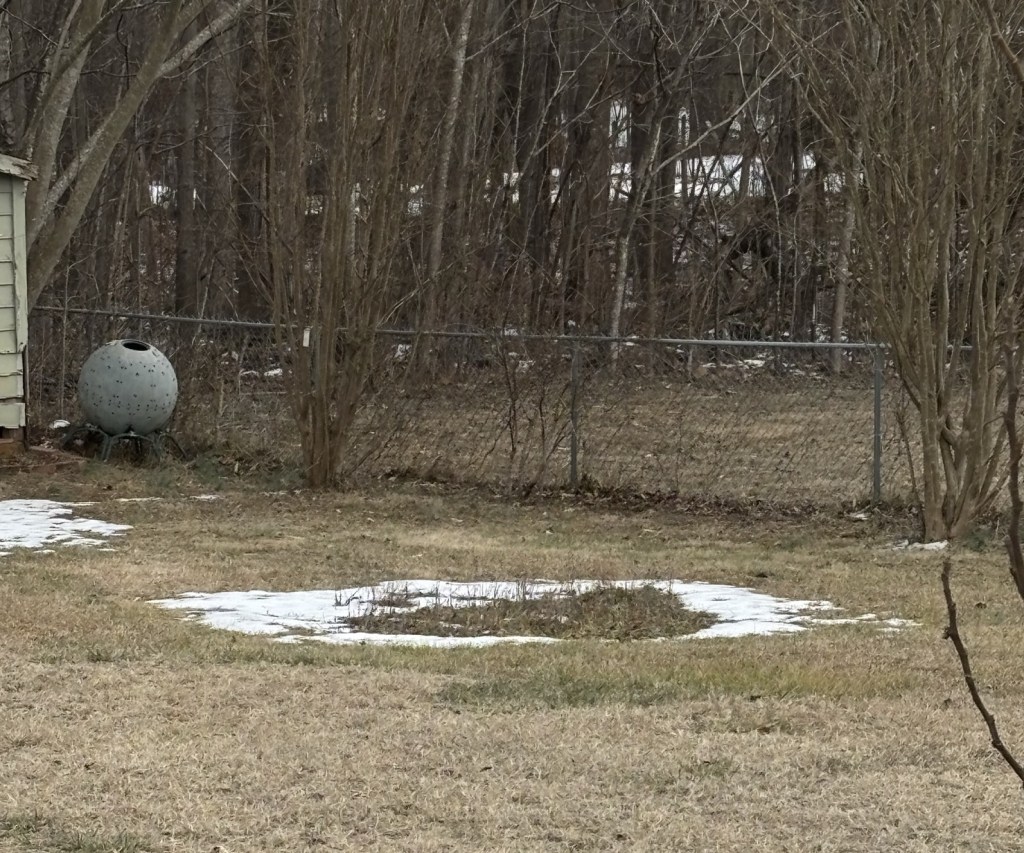
    This is peculiar. Most of our yard is melting in ways that make sense. the shady spots going more slowly than the sunny ones.

    Then, there’s this.

    This spot got a big pile of yard trash piled up that was, eventually, burned. When nothing filled it in quickly, I sprinkled it with (bought) garden soil and wildflower seeds. We’re waiting to see what comes back from that with great anticipation.

    Is it the composting effect of what grew there this summer that is causing the ring?

    I’ll be asking Taylor about that next Wednesday after our Pruning class.

    Addendum:

    He said it probably has to do with the amendment I made to the patch when I was planting the wildflower seeds making the soil retain heat differently.

  • Feeding birds

    February 1, 2026
    a day in this life, birdwatching

    Kae Audhild wrote a review of a very attractive birdfeeder this morning and I didn’t want to fill up her Comments with my thoughts on the subject. So, here we are.

    There was a fairly short period in Vash’s life when he liked to wander at night. I started leaving a dish of kibble out for him on a table by the kitchen window. He eventually decided that inside with snuggles was better than whatever he’d been getting up to. He was neutered. So, it wasn’t that.

    Because of the kibble dish, we got to see a possum up close. And, one snowy day, a pair of cardinals were glad to find a snack. That inspired us to get a feeder.

    Unfortunately, we have particularly greedy squirrels living in our back trees and they could clean out a feeder in half a day, leaving nothing for the birds. I was bitching about it and someone told that there are such things as effective squirrel proof feeders. I investigated and found that Squirrel Busters are highly rated.

    They aren’t cheap. But, they hold up well and they really do work. The springs in ours have lasted for over a decade and are still going strong. Bonus has been watching them frustrate fat squirrels.

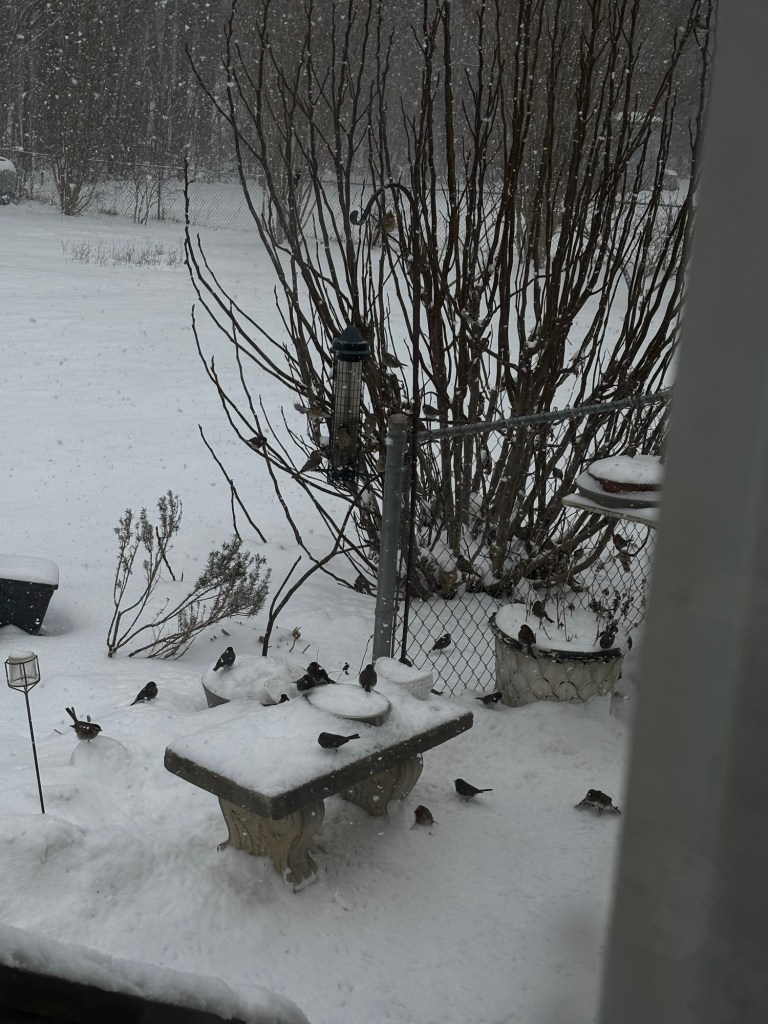
    We have 2 small feeders on the front stoop and a larger one off the back patio. Chuck tried a different brand in the front, briefly. But a bear mangled it. It still works. But it isn’t as springy as the other 3. So, it has become our reserve bird feeder for times of particularly bad weather. Like now when we have 4 inches of snow on the ground.

    We started with all-purpose bird seed that had sunflower seeds, thistles and millet. There was probably other stuff, too. But, it’s been a while I don’t remember what all was in it. It looked like the birds that came, in the early days, threw out the millet to get to the good stuff. They may have eaten some. But it didn’t look like it. They absolutely flung it out. And then it sprouted in the flower bed underneath it.

    So, we switched to millet-free, which means all of one thing because all bird seed mixtures seem to have millet in them. And frankly, I think of it as filler.

    In our area, if you are going to get single seeds, your choices are thistles, safflower or sunflower. Thistles are only attractive to a limited variety of birds and, while we like those birds, they bypassed the thistles when the other option that we used for the rest of the crowd was available. So, no thistles. Also, the woodpeckers have preferred seeds to meal worm blocks. So, we stopped bothering with that, too.

    We tried safflower seeds and they are messy. There’s a kind of papery skin on the seeds that got left all over the place. They’re cheaper than sunflower seeds. But, not enough cheaper to be worth the constant clean up.

    Obviously unshelled sunflower seeds cost less. But, you’re getting less actual food. So, of course they do. AND they sprout. If feral sunflowers make you happy, they’re great. If you don’t want random sunflowers popping up around your yard, they can be annoying. (Chuck mowed around ours and it was pretty, but not our intention.)

    Sunflower hearts and/or chips don’t sprout. Everybody loves them. They don’t leave a mess on the stoop or patio. What gets dribbled by slovenly finches gets cleaned up by doves and juncoes. And I can get big bags at the farm store for slightly less than $2/lb., which means I don’t have to go shopping for seeds very often.

    As with all things, YMMV. You may not have greedy squirrels that don’t share with other creatures. Your woodpeckers may really like meal worms better than sunflower seeds. You may have enough wind to blow safflower skins off your porch or your feeders may be conveniently hung where it doesn’t matter. This is what works for us.

  • Baby fig update

    January 25, 2026
    dirt under my nails, grow your own, plants

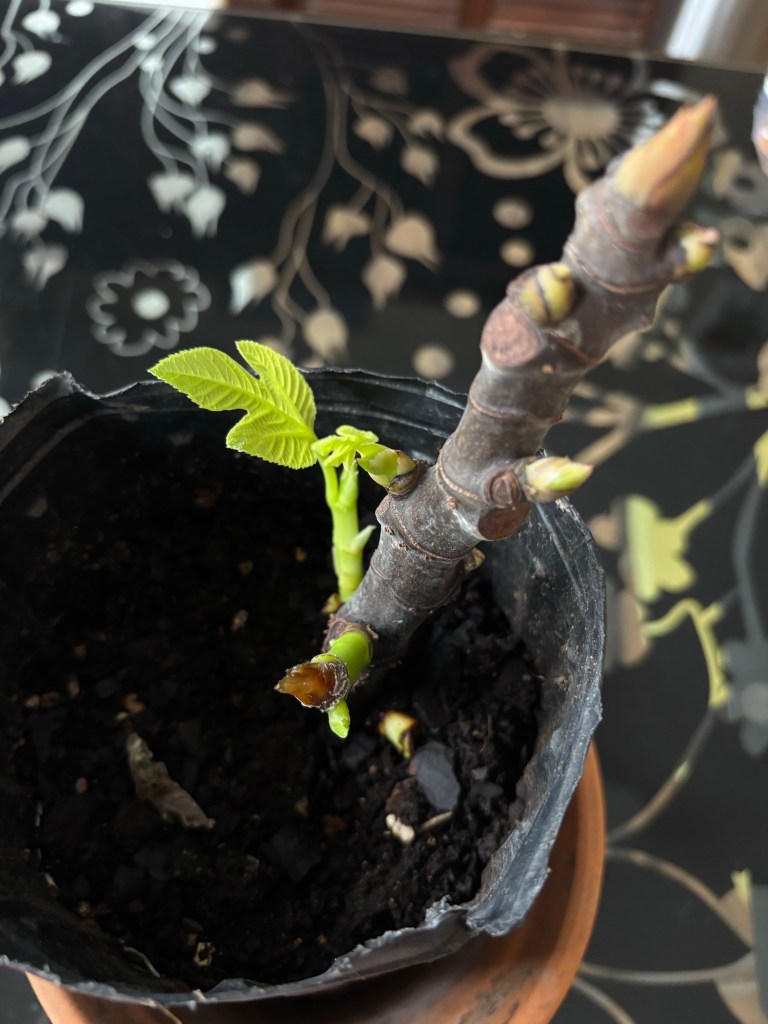
    I almost killed it.

    So….. I got happy with myself about the fig I have rooting in the pot. Aaaaand I watered it and took the baggie off of it.

    That was not a good idea. The largest leaf died and one of the the side shoots started to dry up.

    I put the baggie back over it and it seems to be recovering.

    It’s sitting in the kitchen window with the baggie back over it, now. It will stay there, with its baggie, until my friend is ready to take responsibility for it.

  • Grotesques by the side of the road

    January 20, 2026
    Stop the car

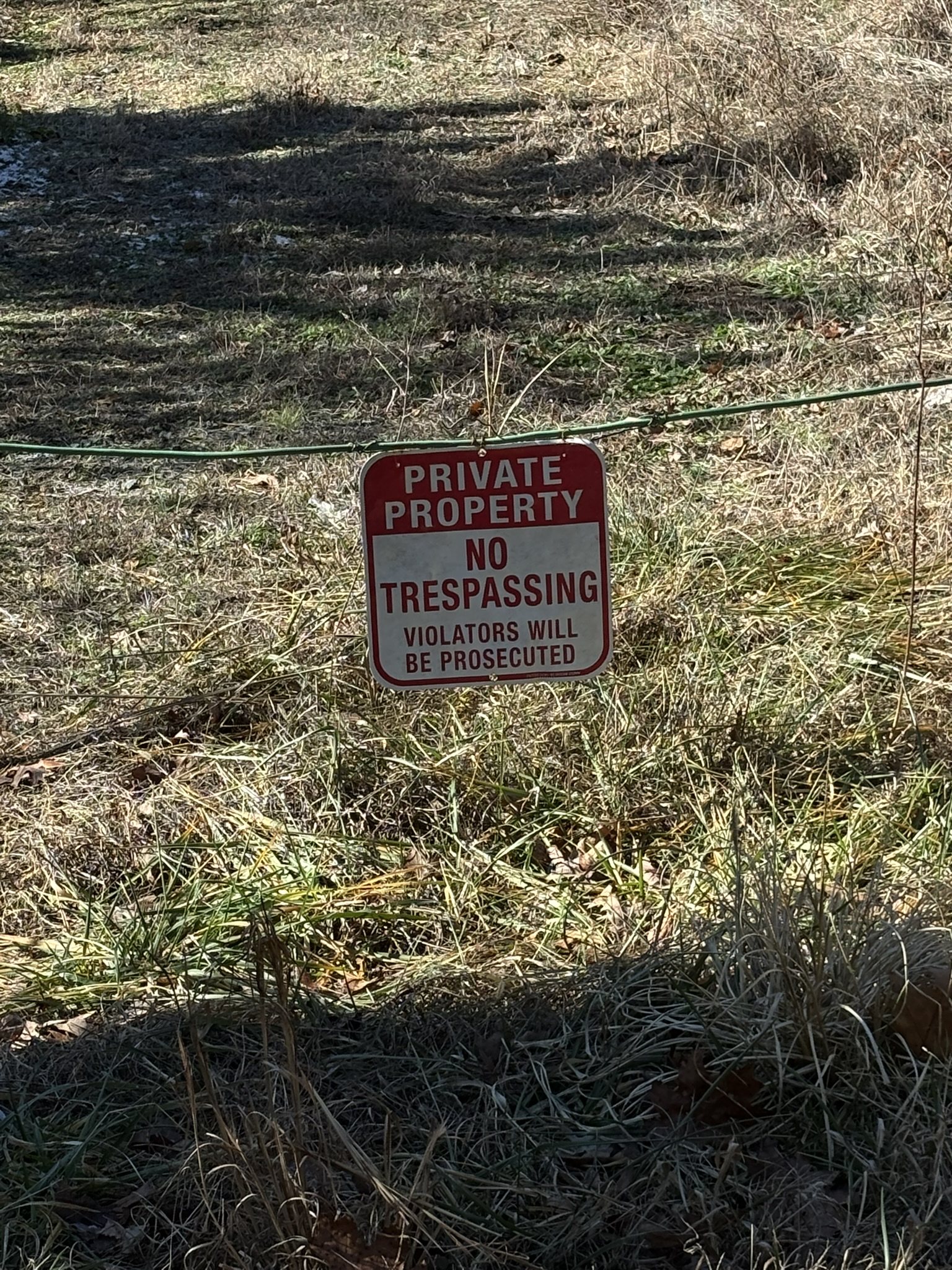
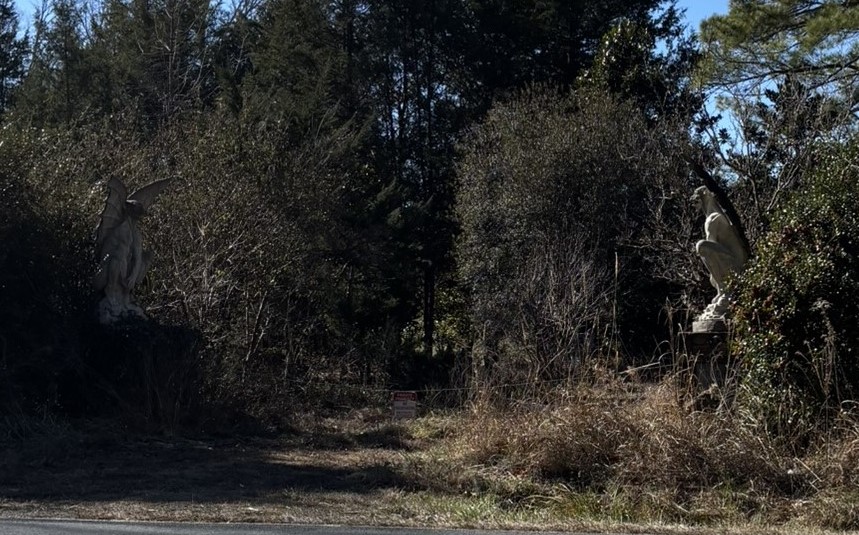
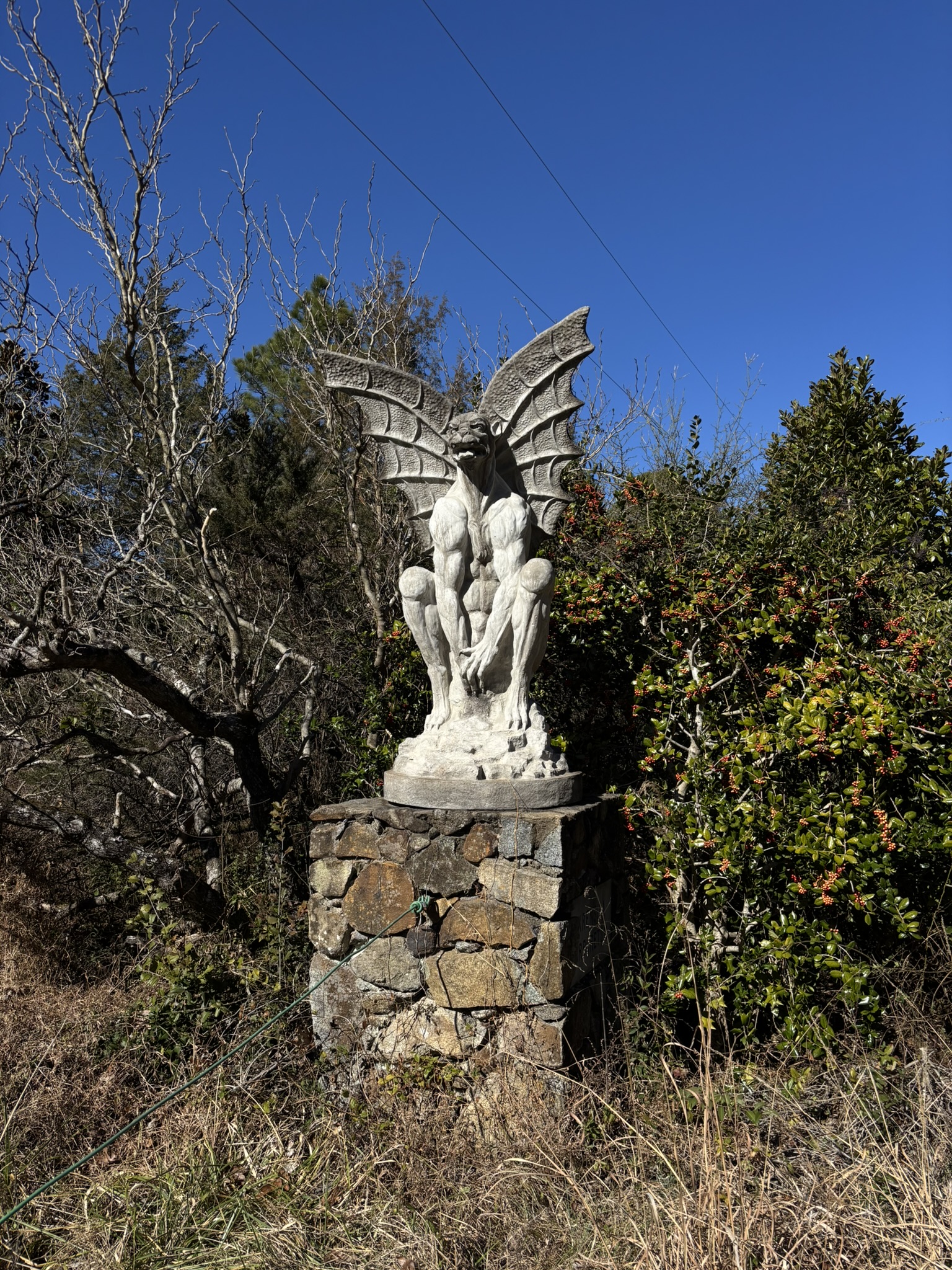
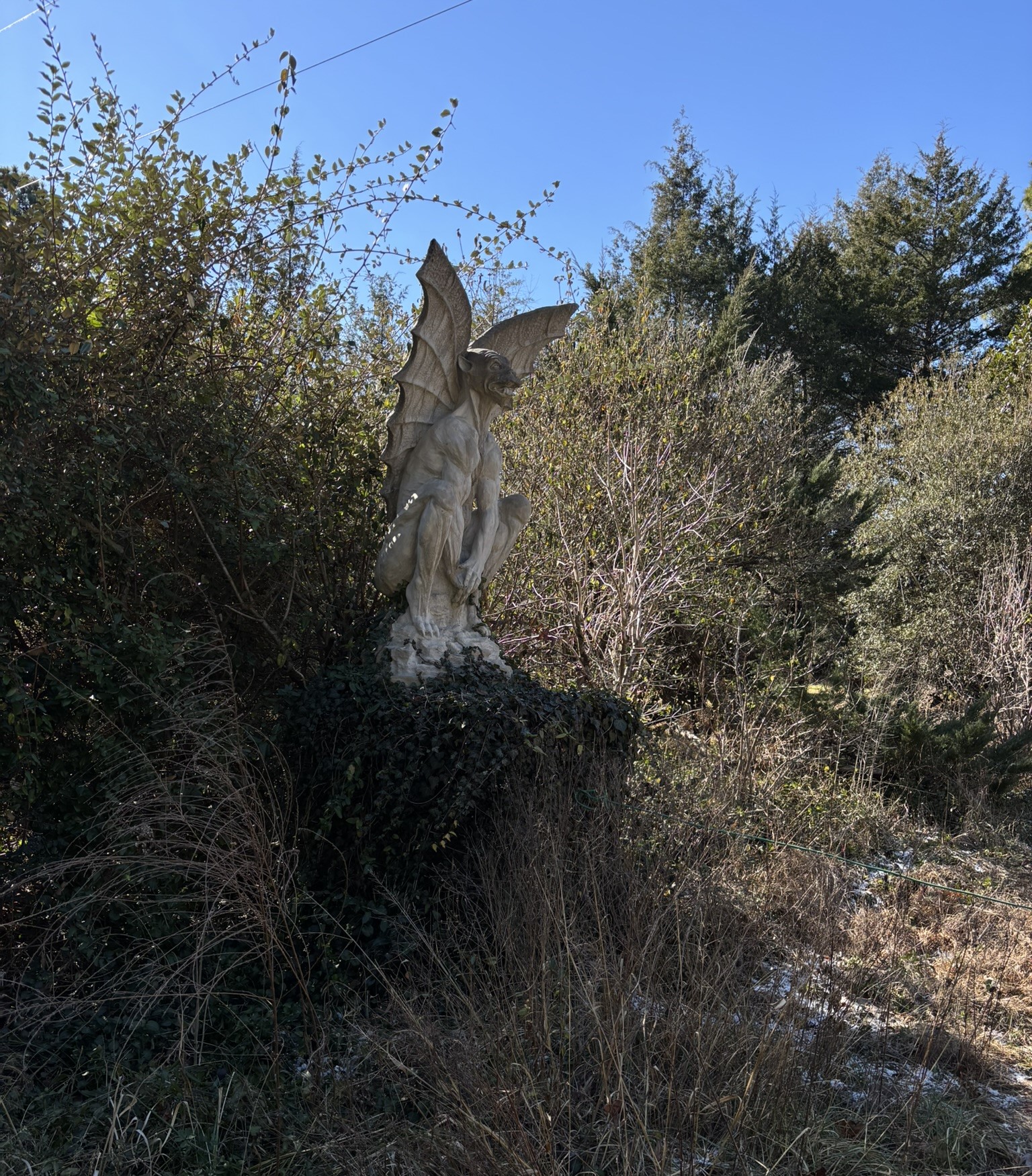
    Several years ago, I was driving toward Pittsboro, taking a country road rather than a highway. As I was going about 45 mph (because White Cross Road at the county line is fairly twisty), I saw a tall grotesque looking over the bushes. As I drew even with it, I spotted its partner. They appeared to guarding the entrance to a drive, which had a chain across it.

    https://maps.app.goo.gl/adK8gXuLG1RkncBu6

    I drove passed there recently and it occured to me that you might think they’re fun. So, I went back to get some pictures.

    A little digging around had led me to this article:

    https://www.magnoliasociety.org/2018-Meeting-Schedule

    “Tom Krenitsky’s garden is actually located in Chatham County, but the address is Whitecross Road, Chapel Hill, NC. The name “Krensica Arboretum” is engraved in granite at the entrance. The 83-acre (34-ha) landscaped garden on rolling hills showcases natural stone outcrops, vistas, a creek, two ponds, statuary, a walled garden and plenty of magnolias. Since Tom is a keen amateur magnolia breeder, you will see the results of his efforts, including many hybrids with Magnolia tamaulipana.”

    You can see magnolia trees behind the brush growing along the road, if you know to look for them.

Previous Page
1 2 3 4 … 98
Next Page

Blog at WordPress.com.

I am the Audience

Free and worth every penny paid

  • a day in this life
  • dancing in the field of dreams
  • food & drink
  • Laughing
  • poetry and songs
  • Beautiful
  • dirt under my nails
  • bonsai
  • travel
  • odds&ends
  • Labyrinths
  • birdwatching
  • randomness
web counter
 

Loading Comments...
 

    • Subscribe Subscribed
      • I am the Audience
      • Join 54 other subscribers
      • Already have a WordPress.com account? Log in now.
      • I am the Audience
      • Subscribe Subscribed
      • Sign up
      • Log in
      • Report this content
      • View site in Reader
      • Manage subscriptions
      • Collapse this bar