Taken from their FaceBook Post (https://www.facebook.com/piedmontnaturalhistory/posts/790985473071641)
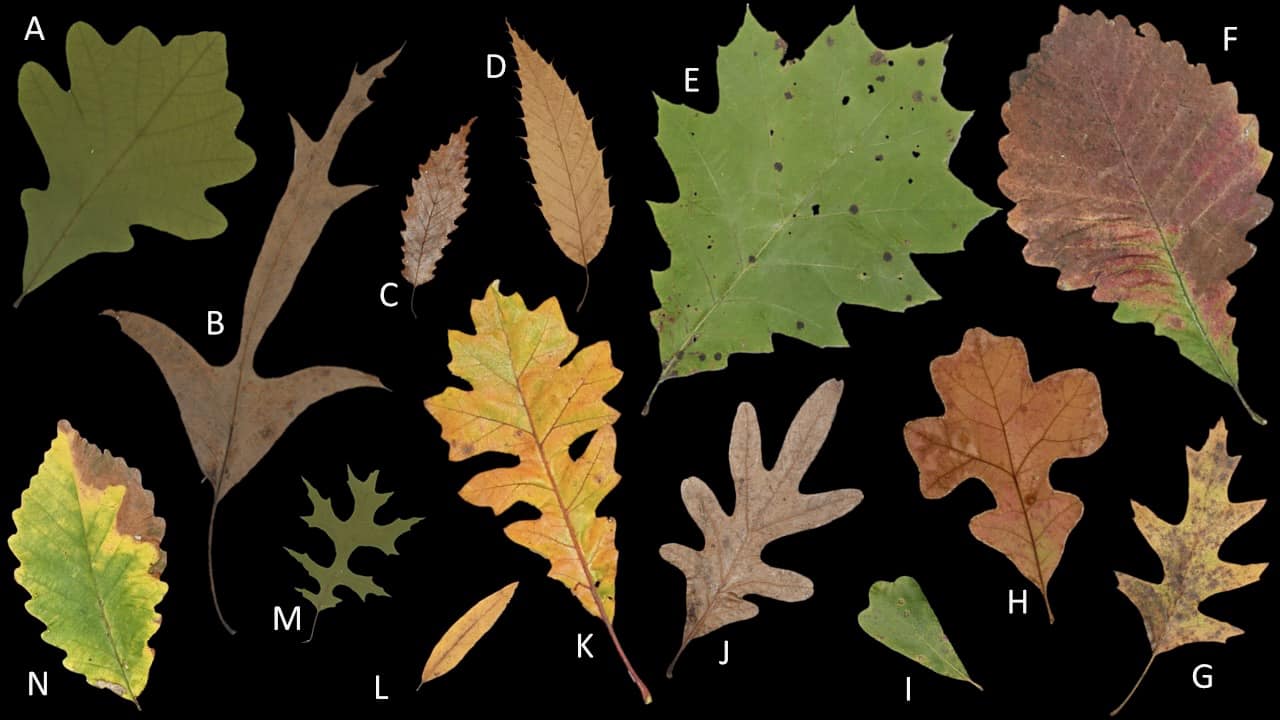
Here are 14 oaks you can find in the eastern and central United States. All but one of them (Sawtooth Oak) are native to this region. If you’ve read Doug Tallamy’s “The Nature of Oaks,” you know that native oaks are the most important host trees in North America for butterfly and moth caterpillars. In addition, if you like to watch or listen to songbirds, our native oaks provide the caterpillar food source for baby birds more than any other tree group.
In general, many oaks can be easily split into two groups, the white oaks and the red oaks. White Oaks have acorns that develop in one year and the leaves have rounded lobes that lack bristle tips. Red Oaks have acorns that develop over two years, so there will be immature acorns on the branches even after the two-year-old acorns drop in autumn. Red Oak leaves have more pointed lobes with bristly tips.
Beyond leaves, though, considering the distribution range, habitat type, and features of the buds, acorns, and bark are often necessary for confident identification. The size and shape of leaves can also vary a lot based on the age of the tree and whether the leaf comes from a sunny or shady branch. To complicate matters further, many oaks hybridize between species, making identification to species challenging or impossible from leaves alone. It’s important to remember that oak trees don’t read the field guides! 
The leaves in this figure by letter are:
A – Swamp White Oak (Quercus bicolor) grows in bottomland forests and wetland margins across the Midwest and Northeast. There are some scattered populations in the Piedmont, though, and it’s also used in landscaping. The ‘bicolor’ in its scientific/botanical name refers to the difference between the dark green and glossy top surface and the much lighter, silvery-white undersides of its leaves.
B – Southern Red Oak or Spanish Oak (Quercus falcata) has pointy lobes and bristles, as expected for a red oak. There’s quite a bit of variation to leaf shape, even within the same tree, but there’s typically a somewhat U-shaped base where it joins the leaf stalk (petiole). The last lobe at the end of each leaf tends to be long and narrow with 3 bristly tips. The underside of the leaves have rusty hairs as well. Southern Red Oaks are common across the southeast in dry upland forests.
C – Chinquapin or Yellow Chestnut Oak (Quercus muehlenbergii) is a native white oak found in the Midwest, but it is sometimes planted in landscaping too. In the wild, it’s often found around limestone outcrops. It has some resemblance to Rock Chestnut Oak, but the leaves of Chinquapin Oak have sharper teeth along the margins. Chinquapin Oak leaves are also much smaller, typically being less than 5 inches long. Its leaves are also smaller and less pointy than the non-native Sawtooth Oak (D) and Chinquapin lacks the hairy acorn cap of Sawtooth Oaks as well.
D – Sawtooth (Quercus acutissima) is a non-native oak introduced from Asia in 1862. It has been widely planted as an ornamental and as a food source for deer and turkeys. Concerns about the escape of sawtooth oak into natural areas has led to it being listed as an invasive tree in 8 states, including Alabama, Georgia, South Carolina, and Kentucky. It’s on the invasive plant watch list in North Carolina. The leaves have the namesake sawtooth margin with a bristle-tip margin to each lobe.
Fortunately, there are numerous oak trees native to America that you can plant as an alternative to Sawtooth Oak. These native oaks also produce abundant acorns for wildlife and their leaves are also a great food source for our native caterpillars, which feed the nestling songbirds that everyone loves to see and hear.
E – Northern Red Oak (Quercus rubra) has pointed lobes with bristly tips, as expected for a red oak. The leaves are wider past the midpoint of their length and they have 7 – 11 lobes with sinuses that go less than halfway to the mid-vein of the leaf. Northern Red Oaks grow in bottomlands and ravines across much of the eastern United States but they are absent from the Coastal Plain. They’re also more common in the north, where they contribute to the beautiful scarlet colors of autumn in New England.
F – Swamp Chestnut or Basket Oak (Quercus michauxii) is a white oak that grows in bottomland forests of the Coastal Plain and Gulf Coast states. There are some scattered populations occur in the Piedmont too. Its leaves are much wider above the midline and they have lots of rounded teeth along their margin. The leaves closely resemble Rock Chestnut Oak (Q. montana; leaf N). The key difference between them, though, is that Swamp Chestnut Oak has proportionally wider leaves. It also differs in habitat and distribution range from the Rock Chestnut Oak. Its scientific name honors the French naturalist André Michaux, who was the Royal botanist of King Louis XVI and an early explorer of the southeastern United States.
G – Cherrybark or Swamp Spanish Oak (Quercus pagoda) is a red oak that grows in bottomland forests of the Carolinas, Georgia, and Gulf Coast. The leaves have a prominent wedge at their base. The name Cherrybark comes from the way the bark of mature trees can resemble that if a black cherry. The specific epithet of its scientific/ botanical name refers to the resemblance of its leaves to the tiered shape of a pagoda.
H – Post Oak (Quercus stellata) is a member of the white oak group, so notice its rounded lobes that lack bristles. Post Oaks have 5 lobes that form a Maltese Cross shape. The leaves also have a leathery texture. Post Oaks are native to the southeast in dry, rocky upland soils.
I – Water or Paddle Oak (Quercus nigra) is a red oak native to a wide range of habitats, including bottomland forests, uplands and fields. The leaves are highly variable in shape and they may or may not have lobes. Two features to look for on the leaves are that they are generally widest near the tip and have a wedge-shaped base. They’re also relatively small, often being less than 4 inches long. Water Oaks are widely planted in parking lots and along streets. They grow fast, but generally live less than 50 years. They drop a large number of ~1/2 inch long acorns that are eaten by rodents, deer, wild turkeys, songbirds, and many other wildlife.
J – Eastern White Oak (Quercus alba) has leaves with rounded lobes that lack bristly tips. The number of lobes is variable, ranging from 7 – 10 and they can show considerable variation in sinus depth between leaves. Eastern White Oaks hybridize with Post Oaks and Swamp Chestnut Oaks, which adds to their leaf variation. This is one of the most common oaks to find on a hike in the southern Piedmont and they’re native to the eastern US in both uplands and bottomlands.
K. Overcup Oak (Quercus lyrata) is a white oak that can be found in bottomland forests of the Atlantic Coastal Plain and Gulf Coast states. It often grows in habitats that flood after thunderstorms. You’ll occasionally find one growing in the Piedmont and they’re used in landscaping too. Overcup Oak leaves are widest above the midline and typically have 7 lobes. Some of the sinuses often have a flat bottom. The best feature to identify them may be their acorn, which has a cup that nearly encloses the entire nut.
L – Willow Oak (Quercus phellos) is native to moist, bottomland forests of the South, but is very amenable to urban areas too and it has been widely planted in parking lots, roadsides, and parks. The lance-shaped leaves resemble the leaves of a willow, hence the common name. If you look closely at the leaf tip, you’ll often find a short bristle sticking off the end. Its abundant acorns provide food for game birds such as wild turkeys and a wide range of song birds and mammals.
M. Pin or Swamp Oak (Quercus palustris) is a member of the red oak group. Its leaves have 5 to 7 lobes with deep, U-shaped sinuses between the lobes. Pin Oak often grows in moist bottomlands with clay soils in the wild, but it has been widely planted for landscaping as well. In the wild, you can find it growing in the Midwest south of the Great Lakes east to New Jersey and North Carolina. The ‘Pin’ name refers to the thin, pin-like branchlets that often arise from the smooth bark of its branches. The orientation of the branches is one tip for identifying this tree from a distance. The lower branches often droop downward, the middle branches grow perpendicular to the trunk, whereas the upper benches point upward.
N – Rock Chestnut Oak (Quercus montana) is a white oak that grows in upland forests of the Appalachian Mountains and adjacent Piedmont. The leaves can be up to 10 inches long and they have many rounded teeth along their margins. The key difference from Swamp Chestnut Oak (F) leaves is that Rock Chestnut Oak leaves are proportionately narrower.
 I am the Audience