-
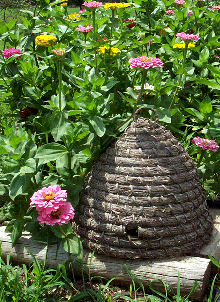
The old fashioned kind of straw hives seen in childrens’ books are called skeps and they are simply empty cavities for the bees to do with as they will. They give bees a place to live, but the whole hive has to be destroyed in order to remove any honey or to check for diseases so they really aren’t a good choice if you want to keep that colony.

There are, generally, 3 types of beehives used by modern beekeepers. They all have movable parts that allow beekeeper access to the comb so that they can to check on brood and to harvest honey.
The Langstroth hive was patented in 1852 by an American clergyman named Lorenzo Langstroth and is used by commercial beekeepers because they are easy for humans to manage. They have frames that guide how the bees make their comb and they frequently have wax foundation to give the bees a start. This helps beekeepers have more standardized comb that makes honey harvesting easier. The frames also allow the use of centrifuges (called extractors) to remove the honey from comb that has had the caps sliced off. After honey extraction, the frames are put back in the hives where the bees get to work cleaning the cells up and refilling them, using less resources to get back up to speed than when other types of hives are used. The frames are also sturdier than free hanging comb and, therefore, are easier to transport to crops that need pollination or to get a particular type of desirable honey flavor like tupelo, orange blossom or sourwood.
Langs generally have a brood box on the bottom and honey boxes “super”-ed above the brood. Supers may be deep, medium or small. Some commercial beekeepers use a queen excluder to keep her from climbing up into the supers and laying brood where the beekeeper is trying to acquire harvestable honey. If there is brood, the honey can’t be used. But if the nectar flow is good and they have enough space, this isn’t a problem.

The “nationals” of the UK are a variation on this theme.
Top Bar and Warré hives are often preferred by “natural” beekeepers. (There was some argument on the email list of our local beekeepers association, with some holding that any bee tending is unnatural and that the term is an oxymoron. Whatever.) Natural beekeepers’ purpose is to support the health and well-being of honeybees with as little intervention as the humans can bear to let happen. Some people have an easier time keeping out of it than others. Chuck occasionally has to talk me down. We have determined how we intend to look after the bees and when I get to frettin’, he reminds me of what we know and what we have decided is our way of bee support.
Anyway, the point of these other varieties of hive is to try to provide a space that is more similar to the kind of place bees use when they are completely wild. There are no frames, after all in hollow trees.
Top Bar Hives were developed to be easy to build with simple tools and use without a great deal of fuss. Kenyans have angled sides and Tanzanians have straight sides. (Ours are Kenyan.) They provide a long, hollow space with bars that are spaced to be convenient for bees to build comb down from and also convenient for beekeepers to lift out for honey harvesting. The only lifting you do with TBHs is lifting the top up to get to the bars.
The angled sides is because bees don’t like to attach to angled sides as much as they do to straight sides. They attach support wax, but don’t build all the way out as they do in straight sided frames or hive boxes. Tanzanian TBHs sound like a pain in the ass to me but it does have a little more space.

TBHs provide honey for the bees and the beekeeper. But, because there is no foundation, the bees have to replace to comb from scratch that has been lost when honey was harvested . So, a lot more bee effort goes into comb building than in frames with foundation.. And they have less time to store honey when they have to spend time building comb first. And in order to leave them enough to get through dearths (winter or summer dry periods when nothing is blooming), humans need to take less.
This isn’t a good way for commercial honey producers to house their staff. It is fine if you just want to pollinate your garden and have a little treat for yourself on occasion.
TBHs frequently have windows in the side so beekeepers can look in to see how things are going with out actually removing the bars and disturbing the bees.
Warré, also called a Vertical Top Bar, was developed by Abbé Émile Warré in the middle of the 20th century. The Abbé’s book on beekeeping, translated by Patricia and David Heaf, can be found HERE.

Warré hives work on the principal that bees draw comb down. So, the main colony is in the top and the lower space is where honey storage happens. They use bars rather than frames and have a quilt in the top to absorb moisture and to help insulate against extreme heat and cold.
Abbé Warré believed that bees don’t need human help and users of Warrés mess with the bees the least, generally opening the hives only twice a year for a checkup and a honey harvest.
There are variations on these, long hives, which are sort of beehive duplexes, Perones, which take Warrés a step further and some others. There are also beekeepers who are using other shapes like hexagons and dodecahedrons to see how those alterations work. But, as far as I can see, these three are the basic starting place for new beekeepers to decide what hive style best suits their way of tending bees.
-
Trees:
Red Maple
Prunus family ( apples, pears, plums, peaches, cherry, etc.)
Crabapple
Redbud
Holly
Tulip poplar
Locust
Sourwood
Chaste treeShrubs:
Oregon grape
Flowering Quince
Trifoliate orange
Blueberry
Winter Honeysuckle
Abelia
Hydrangea
Butterfly bush
Caryopteris
SumacPerenniels:
Winter aconite
Lamium family (henbit, red)
Dead nettle
Blackberry
Raspberry
Joe Pye weed
Echinacea
Salvias
Asters
GoldenrodHerbs:
Lavender
Rosemary
Chives, allium
Borage
Horehound
Oregano
Mints
Heal-AllAnnuals:
Soybean
Cotton
Smartweed
Poppies
Cosmos
Cleome
Clovers
Buckwheat
SunflowersWe have the bold ones.
-
In addition to the four raised beds and one in-the-ground bed that we have for vegetables, we have an orchard. Of course, ours isn’t a collection of trees in straight rows, but it is an orchard nonetheless. All it takes to be an orchard is 5 fruit trees.
A couple of years ago, I was driving past Southern States and their sign said “Fruit trees in stock now.”. It seemed like my car turned in of its own volition. Everything I got said it was self pollinating, but when I got home the plum had an additional tag that indicated that it needed a coconspirator. I was going to take it back to exchange it, but my son asked how 2 plum trees was a bad thing and since he was right, I just got another variety.
So, we have a Keiffer pear, A White Princess peach, a Santa Rosa plum, an Elephant Heart plum, an apricot, a sour cherry, a pomegranate bush and a Honeycrisp apple tree.
I got a crabapple to cross-pollinate the Honeycrisp, which I ordered in line, but they don’t bloom at the same time, so I’m rethinking that. I’m going to give the bees a year or 2 before putting in another apple. Honeycrisp may not like our weather, but it’s the only one we really care to eat. If I do add another apple, it’ll be a pie apple tree.
We were given a money gift for a wedding present and we used it to buy a little pecan tree. I have no clue how long it will take before that produces.
We have tried planting a fig bush 3 times. The first 2 died. We have planted the most recent iteration in the flower bed by the house hoping that it will have adequate protection from the winter weather there to finally thrive.
This past weekend, I went to Southern States to get some hyacinth and daffodil bulbs and wandered past the fruit trees. Which were marked down 25%. And there was a damson plum, which happens to be Chuck’s favorite jam.
If you were in the area and saw a red New Beetle going down the road with a tree sticking out of the sunroof, that was me.
-
One day Mara, the Evil One, was travelling through the villages of India with his attendants. he saw a man doing walking meditation whose face was lit up on wonder. The man had just discovered something on the ground in front of him. Mara’s attendant asked what that was and Mara replied, “A piece of truth.”
“Doesn’t this bother you when someone finds a piece of truth, O Evil One?” his attendant asked. “No,” Mara replied. “Right after this, they usually make a belief out of it.”


 I am the Audience