-
The hives aren’t in their permanent spot, yet. We will be using pavers I hated in the front yard as a base for them and we’re putting them just inside the treeline where we don’t mow anyway.
And the general rule of thumb is that you move hives 2 inches or 2 miles. Bees go back to the place they last left. If you move a hive across the yard, they will keep trying to go to the old location. Move it 2 miles away and they learn everything new.
When beekeepers want to move a hive a little bit, they get permission to move the hive somewhere for 6-8 weeks, then bring it back to the place they want to keep it.
-
She travels in her own carriage and has attendants who wait on her antennae and foot.
When they arrive in a wire mesh box about the size of a shoe box, she will be in her own little box about the size of a deck of cards. There will be a plug in her box made of candy that is something like a hard marshmallow.
Since the bees in the package aren’t related to her, they will have the 3 days it takes for her and them to eat the plug to let her out to get used to each other and for the colony to become accustomed to her pheromones.
Queen pheromones are what keep everyone happy and wanting to come home when they forage. Bees are the prime example of “When Mama’s happy, everybody’s happy.”
When you look for the queen in the hive, she has a longer abdomen to hold all those egg laying organs, which are present but dormant in the workers.
She spends all her time laying @1,500 eggs a day and workers bring her food and make sure she is comfortable. Comfortable being 93-95ºF all year long.
Water is used to cool the hive in the summer. In the winter, they all crowd together in a ball, dislocate their wings and move their wing muscles as though they were flying to create heat by friction. The queen is in the center of the cluster. The workers circulate in to the center and out to the edge, similar to penguins.
-
In addition to some Cardinal Climber vine (Ipomoea x multifida), cleome and French lavender seeds for the flower beds, we have added more Sow True vegetables:
Beet (Detroit Dark Red)
Beet (Early Wonder)
Parsnip (All American)
Pepper, Chile (Ancho/Poblano) -
The white box hives you usually see are Langstroth hives, devised by Rev. L. L. Langstroth in the 1850s. He figured out the exact size of bees space (1/4-3/8 inch) which is the distance needed between combs for bees to be comfortable. Basically, it’s the space need for 2 bees to pass each other conveniently. So, Rev. L created a box with removable frames for the combs that allowed for bee space, virtually inventing commercial beekeeping on the spot.
This is VERY convenient for humans. Beekeepers start with a brood box for the queen to begin her family and as the colony expands, beekeepers ad supers above the brood chamber for honey stores. Big supers are called “deeps” because they are. There are also medium and small supers. And some beekeepers use queen excluders to keep her from laying eggs in the comb where the honey is collecting.Langstroth hives also use a foundation that the bees draw their comb out from. I have read that this tends to make larger cells than bees do on their own, which is great for honey production.I know of 3 other types of hives that have removable frames.Warré are stacked but with the empty boxes added to the bottom and they use frames without foundation. There are also Kenyan Top Bar Hives and Tanzanian Long Hives, which don’t add to the top and use top bars that the bees draw the comb down from on their own, with the only support that which they create as the build out to the side of the hive.Skeps, the straw hives that make you think of Winnie-the-Pooh, don’t have removable frames so when a beekeeper takes honey, s/he does a lot more damage to the hive than the other ones I just mentioned.We are using KTBH because we think that it looks the most bee- friendly. There is one person in our area, that we know of, who is using a long hive. I look forward to an opportunity to see hers at some point.They have flaps on the side with plastic windows, so we can look in without disturbing the girls as much as removing the top would.And they really are cute. The fact that they have flowers on the ends just cracks me up. We’re hoping that the fact that they don’t look like Langstroth hives makes them kinda stealth so it won’t freak out the neighbors so much.
Here’s a thing I learned that amazed me. Blueberries are pollinated by bees, but the openings of the flowers are too small so bumbles make holes in them and honeybees use those holes to get to the nectar and pollen, too.
AND it takes many visits by bees to pollinate cucumbers. Like around a dozen. And no bees, no cukes.
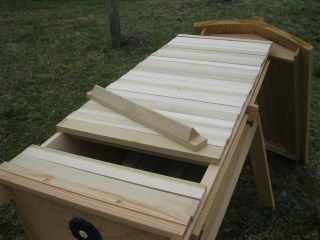 The hive is a big empty box with the bars across the top. The angle of that pointy bit is cut to be right for the bee space.
Langstroth hives use 4 sided frames that usually have a foundation put on by the beekeeper. They are more supportive of the comb allowing th beekeepers greater ease when checking the hive and they make it easier to harvest the honey.

-
Subscribe
Subscribed
Already have a WordPress.com account? Log in now.
 I am the Audience