• Excerpts from ‘The Last Viridian Note by Bruce Sterling

    June 12, 2015
    a day in this life, reading

    You will need to divide your current possessions into four major categories.

    1. Beautiful things.
    2. Emotionally important things.
    3. Tools, devices, and appliances that efficiently perform a useful function.
    4. Everything else.

    “Everything else” will be by far the largest category. Anything you have not touched, or seen, or thought about in a year — this very likely belongs in “everything else.”

    You should document these things. Take their pictures, their identifying makers’ marks, barcodes, whatever, so that you can get them off eBay or Amazon if, for some weird reason, you ever need them again. Store those digital pictures somewhere safe — along with all your other increasingly valuable, life-central digital data. Back them up both onsite and offsite.

    Then remove them from your time and space. “Everything else” should not be in your immediate environment, sucking up your energy and reducing your opportunities. It should become a fond memory, or become reduced to data.

    It may belong *to* you, but it does not belong *with* you. You weren’t born with it. You won’t be buried with it. It needs to be out of the space-time vicinity. You are not its archivist or quartermaster. Stop serving that unpaid role.

    —

    Beautiful things are important. If they’re truly beautiful, they should be so beautiful that you are showing them to people. They should be on display: you should be sharing their beauty with others. Your pride in these things should enhance your life, your sense of taste and perhaps your social standing.

    They’re not really *that* beautiful? Then they’re not really beautiful. Take a picture of them, tag them, remove them elsewhere.

    —

    All of us have sentimental keepsakes that we can’t bear to part with. We also have many other objects which simply provoke a panicky sense of potential loss — they don’t help us to establish who we are, or to become the person we want to be. They subject us to emotional blackmail.

    Is this keepsake so very important that you would want to share its story with your friends, your children, your grandchildren? Or are you just using this clutter as emotional insulation, so as to protect yourself from knowing yourself better?

    Think about that. Take a picture. You might want to write the story down.
    Then — yes — away with it.

    You are not “losing things” by these acts of material hygiene. You are gaining time, health, light and space. Also, the basic quality of your daily life will certainly soar. Because the benefits of good design will accrue to you where they matter — in the everyday.

    —

    Now for category three, tools and appliances. They’re not beautiful and you are not emotionally attached to them. So they should be held to keen technical standards.

    Is your home a museum? Do you have curatorial skills? If not, then entropy is attacking everything in there. Stuff breaks, ages, rusts, wears out, decays. Entropy is an inherent property of time and space. Understand this fact. Expect this. The laws of physics are all right, they should not provoke anguished spasms of denial.

    You will be told that you should “make do” with broken or semi-broken tools, devices and appliances. Unless you are in prison or genuinely crushed by poverty, do not do this. This advice is wicked.

    —

    Get excellent tools and appliances. Not a hundred bad, cheap, easy ones. Get the genuinely good ones. Work at it. Pay some attention here, do not neglect the issue by imagining yourself to be serenely “non-materialistic.” There is nothing more “materialistic” than doing the same household job five times because your tools suck. Do not allow yourself to be trapped in time-sucking black holes of mechanical dysfunction. That is not civilized.
  • That smile

    June 11, 2015
    art, books, reading

    Yesterday, I was listening to Clive Barker’s The Scarlet Gospels.  I’ve really been enjoying it.  It’s incredibly grizzly and completely over the top.  (It’s about Pinhead, of Hellraiser fame; so, that’s to be expected.)

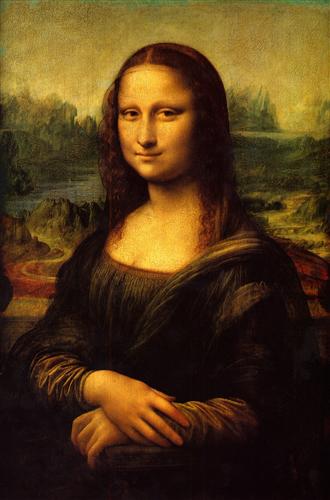
    One of the characters was described as having a “Gioconda smile.”

    The Mona Lisa (La Gioconda or La Joconde, or Portrait of Lisa Gherardini, wife of Francesco del Giocondo)
    The Mona Lisa (La Gioconda or La Joconde, or Portrait of Lisa Gherardini, wife of Francesco del Giocondo)

    I like Barker’s use of language as much as I enjoy the stories he tells.

  • Ruining a steak

    May 28, 2015
    a day in this life, family, food & drink

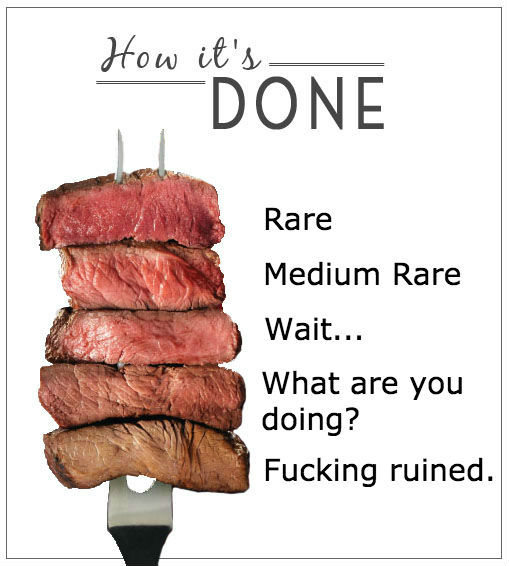
    I saw this graphic on FaceBook this morning and it made me think of my grandmother:

    10502028_1086557851372588_6531066187403953545_n

    Kate grew up in the country. Her father was a farmer with a third grade education. They didn’t always have a lot of ready cash, but they were never, ever hungry. It was kind of a shame that she didn’t like “vegetavles,” because they were abundant. She was a bread-and-meat kind of girl. And, when she was old, she enjoyed going out for dinner to a steak house.

    I took her to a Western Sizzlin’ or whatever equivalent was in Morganton, NC, one time, and freaked out the guy taking our order when she asked for a filet mignon cooked well done. He said “It will be a charcoal briquet if we do that.” She insisted that was always how she had her meat cooked. He found his manager to deal with her because he was at a complete loss for what to do. The manager said, “We can butterfly it and cook it that way, but a filet is too thick to make it well done and still be edible.” I said that would be fine.

    When it came to the table, she was delighted. It was the best steak she had ever had.

    Sometime after that, I took her out for dinner, again, and, again, she ordered a filet cooked to death. The server got this appalled expression and started to say something. I stopped him, smiling, and said, “Just have the kitchen butterfly it and cook it that way. She will be delighted with it.” He kind of shook his head and wrote down the rest of our order.

    And she was delighted. I was, too. It made me happy to have the ability to make her happy and de-stress the people who were helping me do that.

  • Death is Nothing at All

    May 20, 2015
    dancing in the field of dreams

    11088274_848812155166573_1045095440458809325_n

    I found this on FaceBook yesterday.

    “Written by Henry Scott Holland (27 January 1847 – 17 March 1918) was Regius Professor of Divinity at the University of Oxford”

  • My little peach

    May 4, 2015
    a day in this life

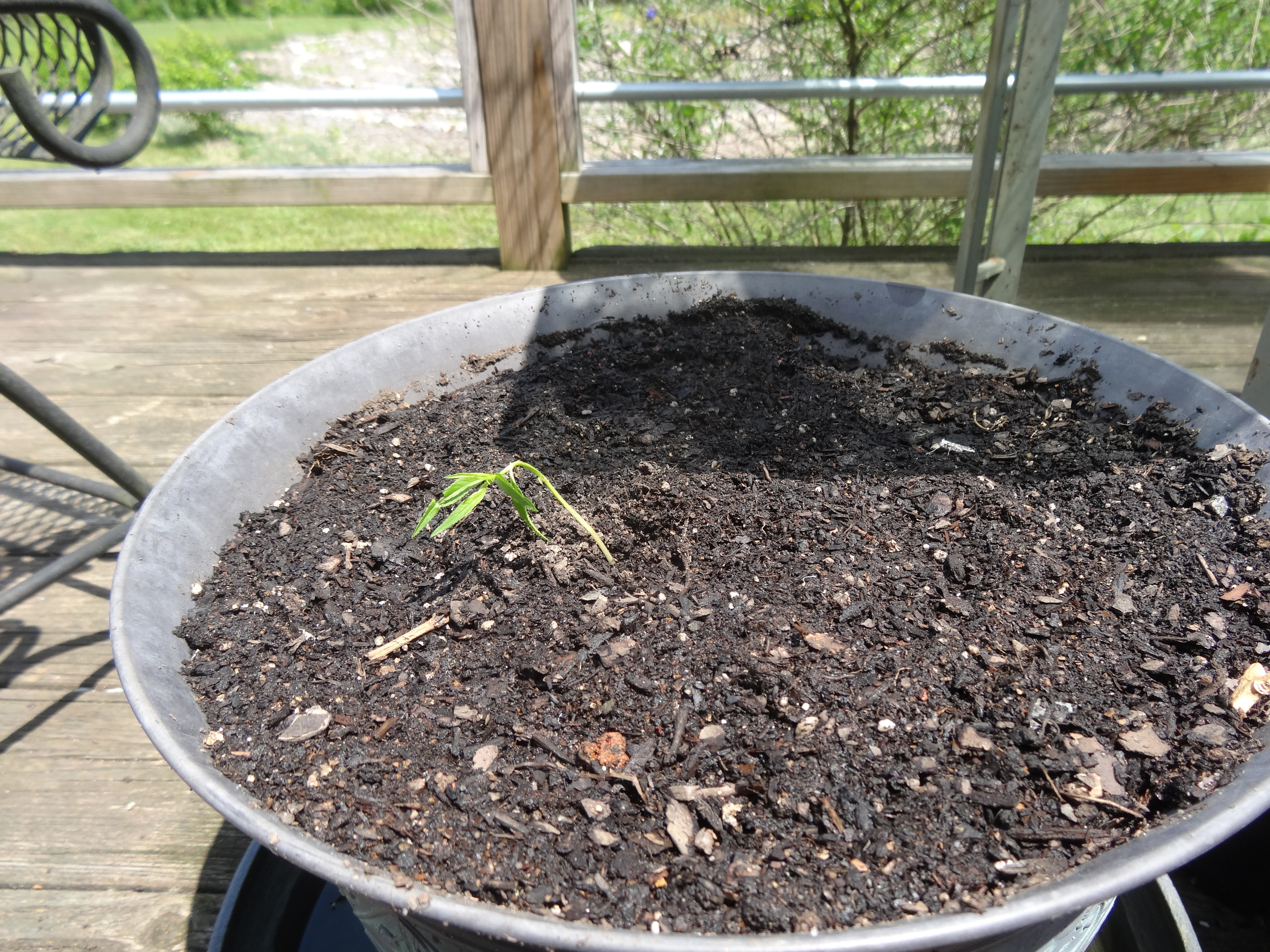
    Last summer we had some delicious peaches.  I stuck 14 pits in one of the potato dirt bags after reading around on the internet to see what would actually work.  They need opportunity to freeze.

    Two sprouted and, because I’m not always the sharpest tack in the box, I killed one.  I didn’t recognize its tiny leaves and thought it was a weed.  The sacrifice of the one saved the life of the other, however.  And it has been moved to a pot my cat isn’t tempted to sleep on.

    DSC05804

    I realize that it looks tiny in that huge pot, but I don’t expect to move it for a few years.

Previous Page
1 … 132 133 134 135 136 … 199
Next Page

Blog at WordPress.com.

I am the Audience

Free and worth every penny paid

  • a day in this life
  • dancing in the field of dreams
  • food & drink
  • Laughing
  • poetry and songs
  • Beautiful
  • dirt under my nails
  • bonsai
  • travel
  • odds&ends
  • Labyrinths
  • birdwatching
  • randomness
web counter
 

Loading Comments...
 

    • Subscribe Subscribed
      • I am the Audience
      • Join 53 other subscribers
      • Already have a WordPress.com account? Log in now.
      • I am the Audience
      • Subscribe Subscribed
      • Sign up
      • Log in
      • Report this content
      • View site in Reader
      • Manage subscriptions
      • Collapse this bar