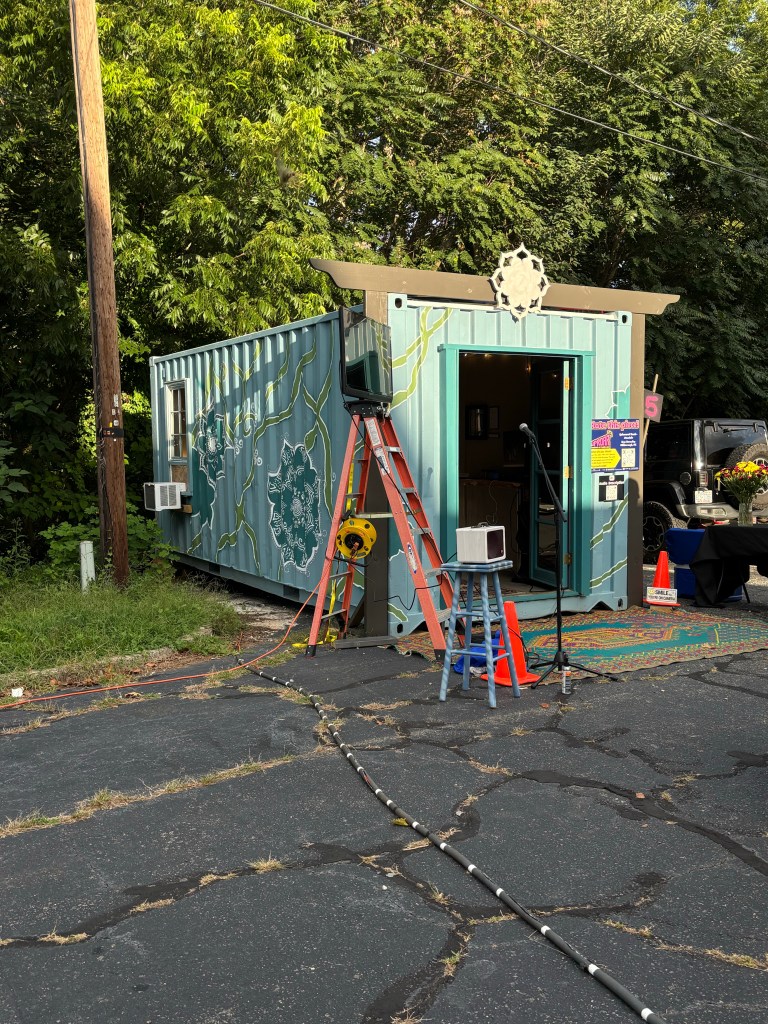
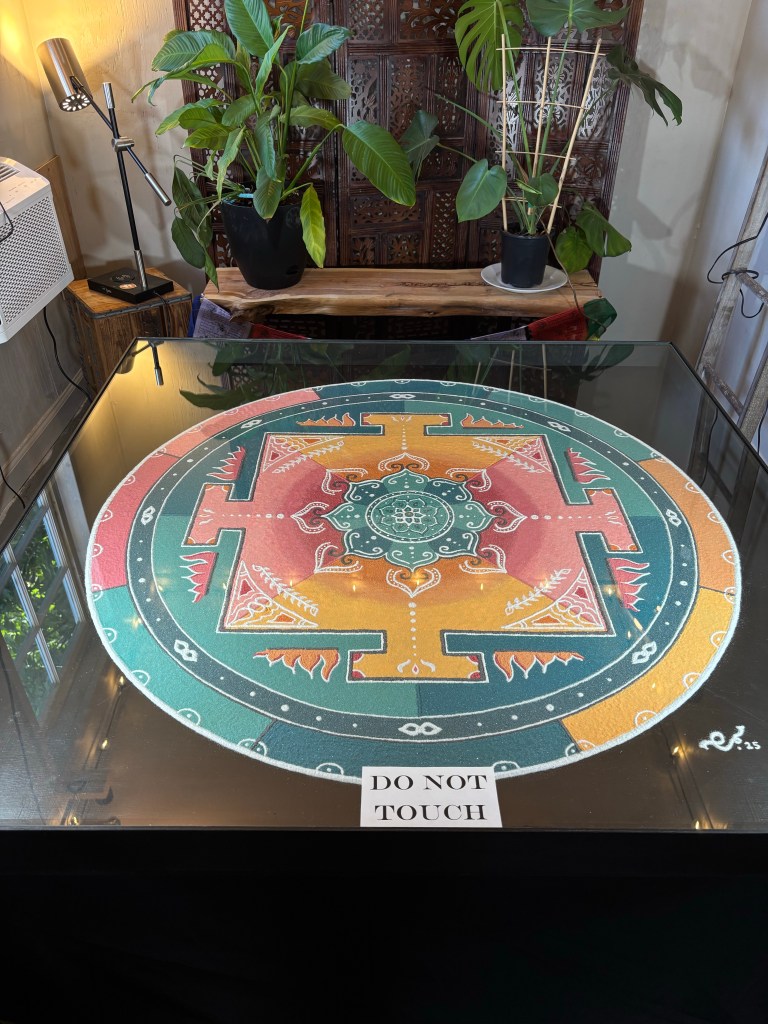
There is a small container in a parking lot off Churton Street in Hillsborough that’s housing a mandala as part of the Uproar Festival of Public Art.
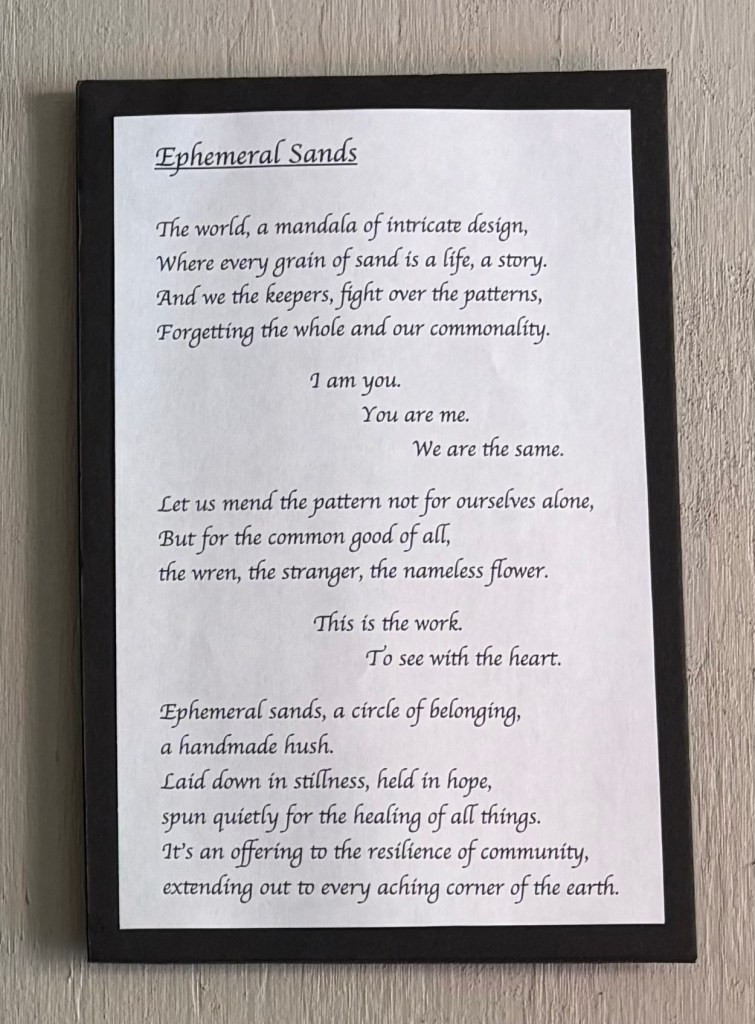
There’s a shelf under the poem with 4 little bowls of sand that you can touch. Each bowl has finer sand than the last going from fairly course (almost like playground sand) to the much finer stuff that is used for mandalas.
The destruction ceremony is tomorrow night and I’m planning to attend.
I’m kind of persnickety about the idea of mandalas. I think they are lovely and understand people wanting to keep images of them. But, when people call a permanent thing they have made a mandala, they seem to be missing the point.
In trying to write a haiku, you have to depend on old ideas in order to be understandable. Using the images of plants that are unfamiliar to the reader make the poem useless, make the reference useless.
If the reader doesn’t know that crêpe myrtles are lush in the summertime but they do know that daffodils come up in the spring, then crepe myrtles aren’t the useful image that a daffodil is. Everyone knows that leaves turn color in the fall. They don’t necessarily know that the colors of the leaves, as they’re bursting in the Spring, give an idea of what those autumn colors will be. If someone doesn’t know that lilies bloom after irises, summer rather than spring, those references may not work.
Obviously, whether those things matter depends on the image that the writer is trying to convey.
I would be curious to see some of the books of words that are published for haiku writers.
My friend, Luke, who is @LessEthereal most places online, is a huge fan of micropoetry. In particular, haiku and haiga. He pointed me to a website that’s doing a haiku-a-day thing for February. (Shortest month for the shortest poetry. Ha!)
They have a page about what haiku actually is and it’s not what American schools teach. They are more interested in what is said than in the number of syllables. And the differences between the languages makes that ridiculous anyway.
Taken from the “Not 5-7-5” article on that website: “Specifically, a haiku tries to invoke the time of year with a word that is typical of that season, such as snow for winter, or frog for spring.” And…” traditional haiku include words that function like a spoken sort of punctuation. More importantly, they cut the poem into two parts, creating a sort of juxtaposition, not only grammatically but also imagistically. The point is to carefully pair two images together in such a way that a shift or disjunction occurs between them. The art of haiku lies in creating the right amount of distance between the two parts, so the leap is neither too far (and thus obscure) or too close (and thus too obvious).”
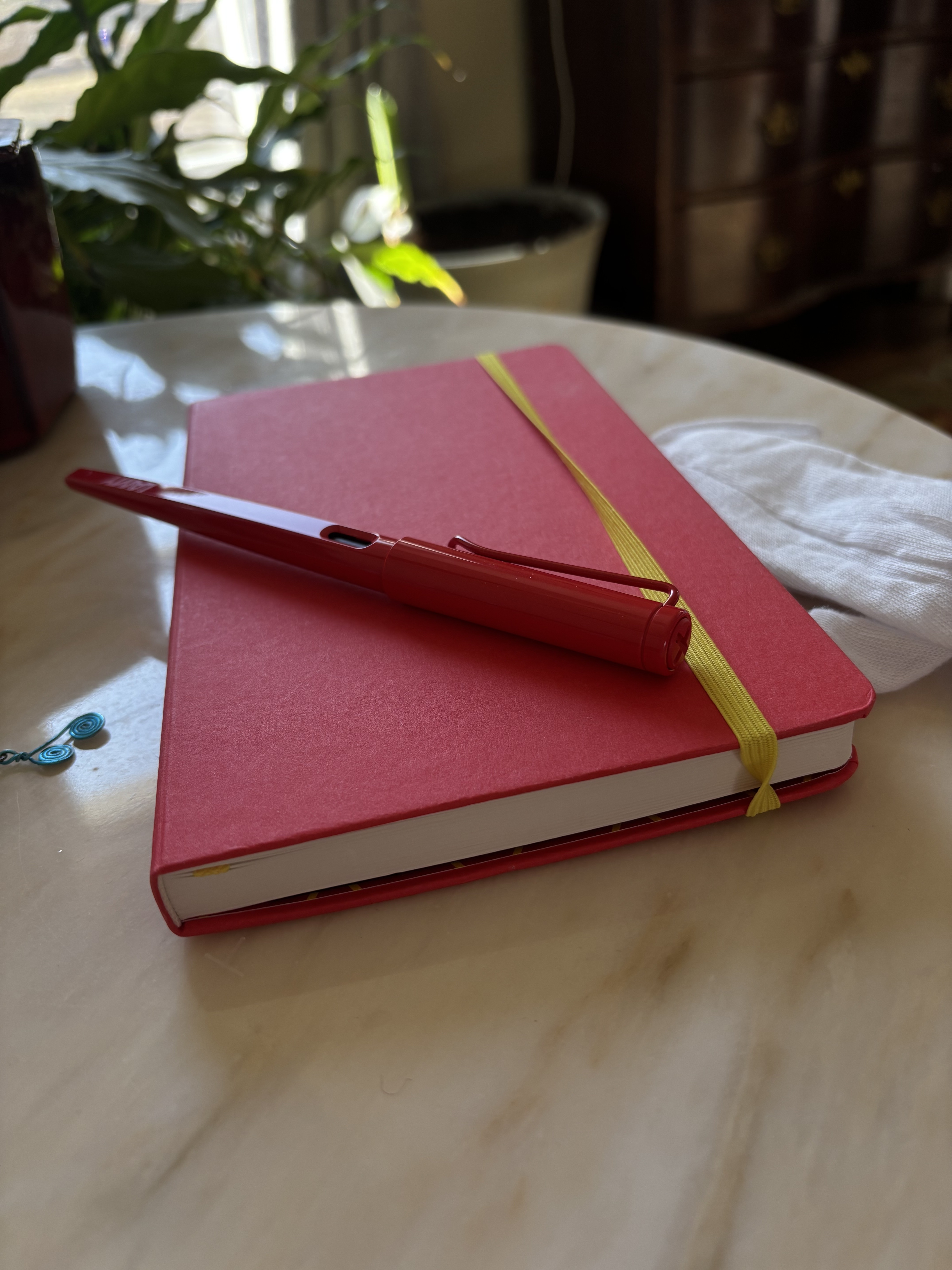
I have a new 1.5mm italic fountain pen that I can only use at home because I have to use ballpoint at work. And I have an empty journal that was lying around the house.
I’m trying to write one thing a day that can lead me into writing sophisticated haiku. If I ever write one that I think ticks all the boxes, I’ll share.
 I am the Audience