I was wandering around, yesterday, and spotted a ‘Pink Storm’ quince with some great trunk action. I’m looking forward to working on it.

No comments on #4
I was wandering around, yesterday, and spotted a ‘Pink Storm’ quince with some great trunk action. I’m looking forward to working on it.
Here are some of my opinions.
If it is a right, you shouldn’t need a law to get to have it. Therefore, everyone should be able to vote and be married or any other thing they want as long as it doesn’t infringe on the personal space of anyone else. The fact that laws are needed for the rights of some to be honored pisses me off.
I want everyone to have the same privileges I do, because I don’t WANT to get something because I’m white. I want it because I earned it. And I don’t want to NOT get it because I’m female. Or have blue eyes or grey hair or for any other accident of birth. And I don’t want your accidents of birth to give you, or keep you from, anything.
I am a believer in a meritocracy. I believe in everyone having the right to Life, Liberty and the PURSUIT of happiness. I don’t believe that you should be allowed to keep other people from those things.
Also, I believe in paying taxes. I want services and I’m willing to pay for them. I want smooth roads, good schools, speedy firemen and EMTs. I would like for everyone to have Medicaire instead of health insurance. I am willing to give up more paycheck in order to have more services available to those that need them. I don’t believe in tax loopholes. Fucking pay your part. You live in the land of the free, help tote the load.
I have been worried about the cedar. The aluminum wire from Michael’s that I used to wire it into the post wasn’t sturdy enough to hold it in firmly when there was a severe windstorm last Fall. But, I was afraid to mess with it much because the roots had already been cut and replanted twice. I was concerned that the roots were too traumatized to tolerate me fiddling with them, then.
It hasn’t looked particularly healthy this winter. I just kept hoping it wasn’t dead and losing its green very slowly. And trying to remember what it looked like in previous winters.
After the workshop in February and some continuous warm days, I decided to get in there and see what was going on. There were healthy roots. (Yay!)
So, I hacked them. I trimmed them up. I worked on the taproot with my new knob cutter so I could seat it better. And I wired it in with copper wire I had picked up from Lowe’s. It was the smallest gauge they had at 10mm, iirc, and still a little bigger than I would have liked. It was hard to bend it. But, that tree isn’t going anywhere unless the whole pot does.
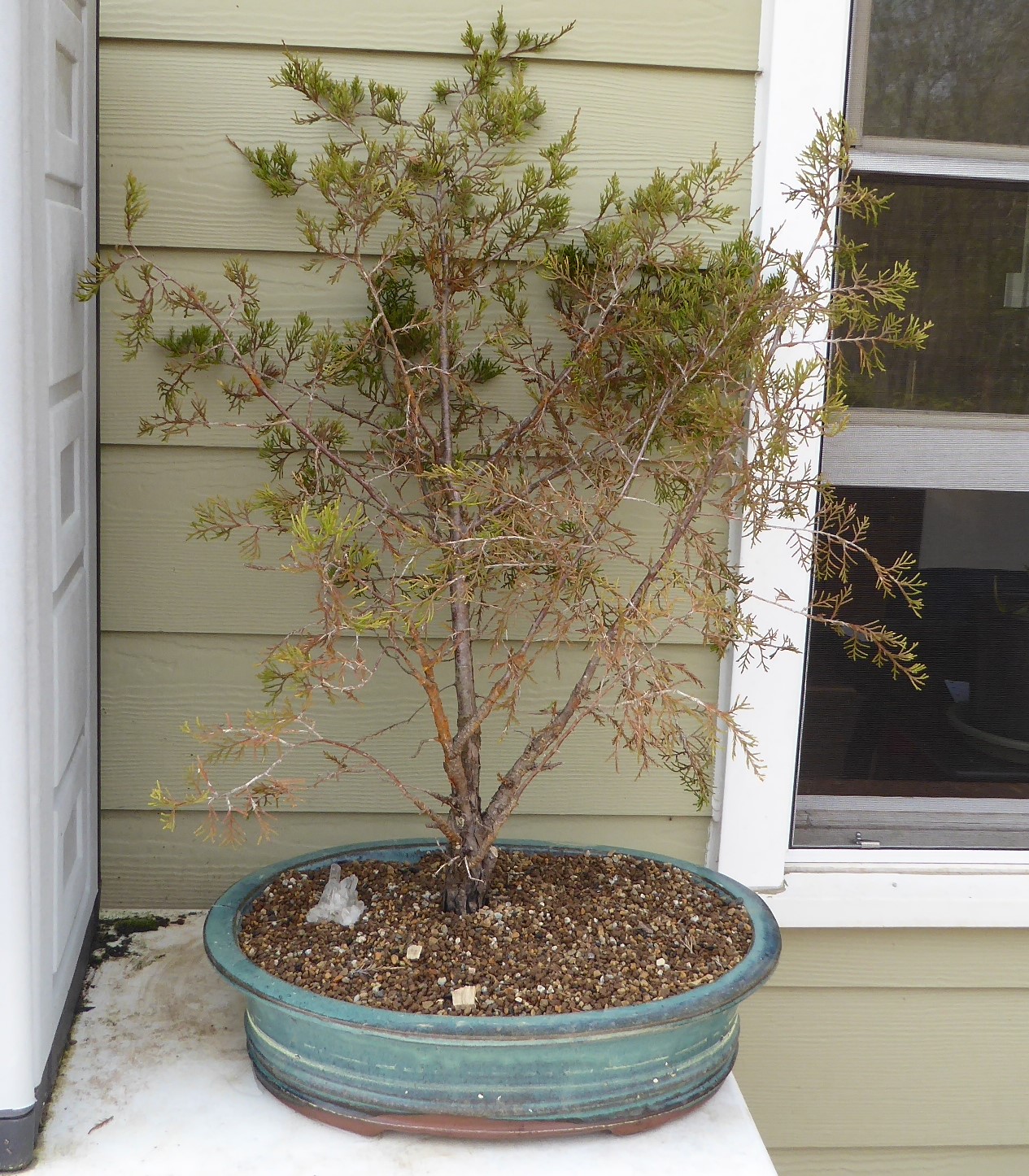
It does have a little bit of a lean. I expect I’ll address that with wire, later.
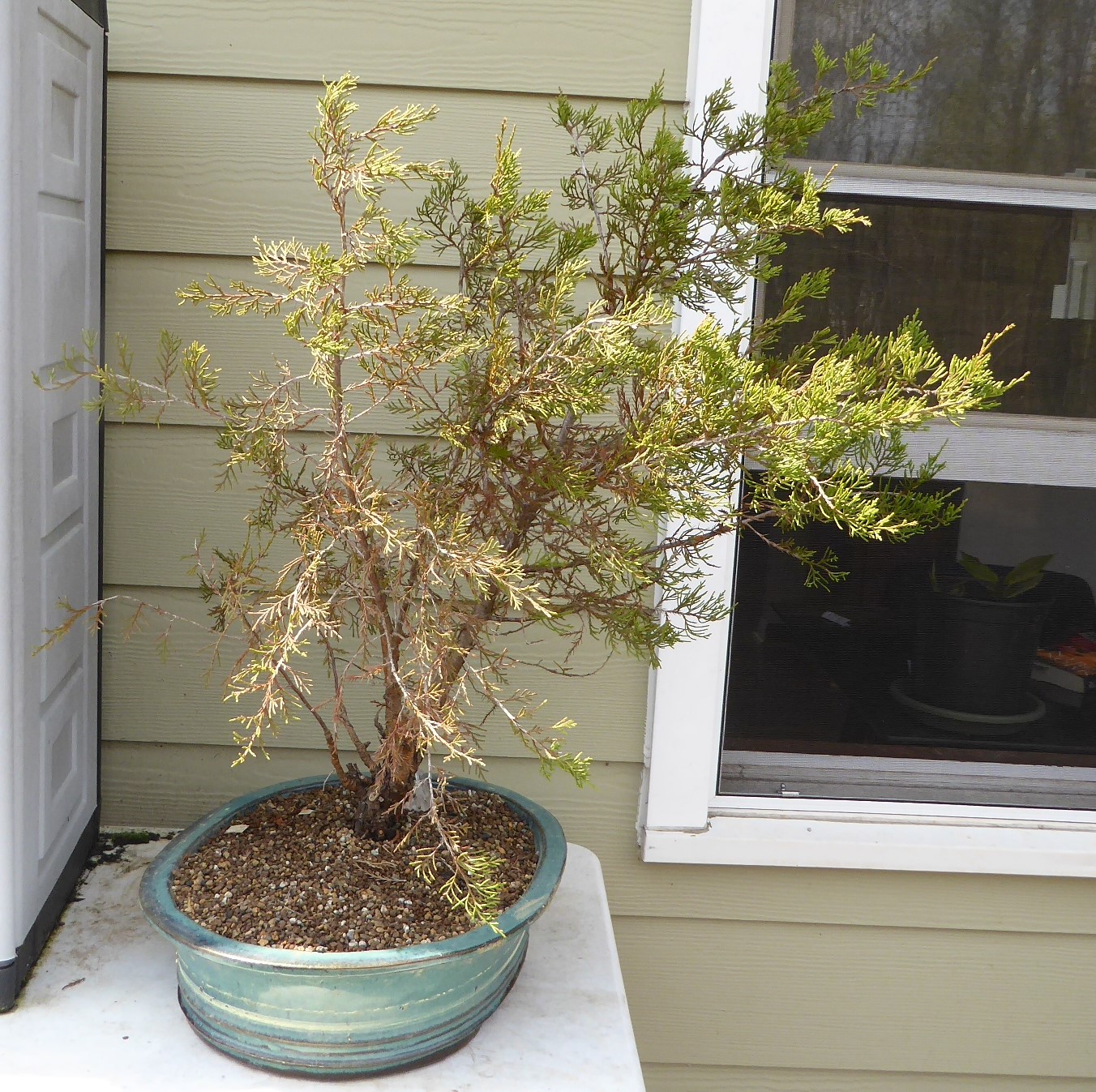
I noticed that it has developed cedar rust, too. Fortunately, Chuck already has some organic fungicide and I’m going to get it tended to tomorrow.


The Japanese maples are leafing out nicely.
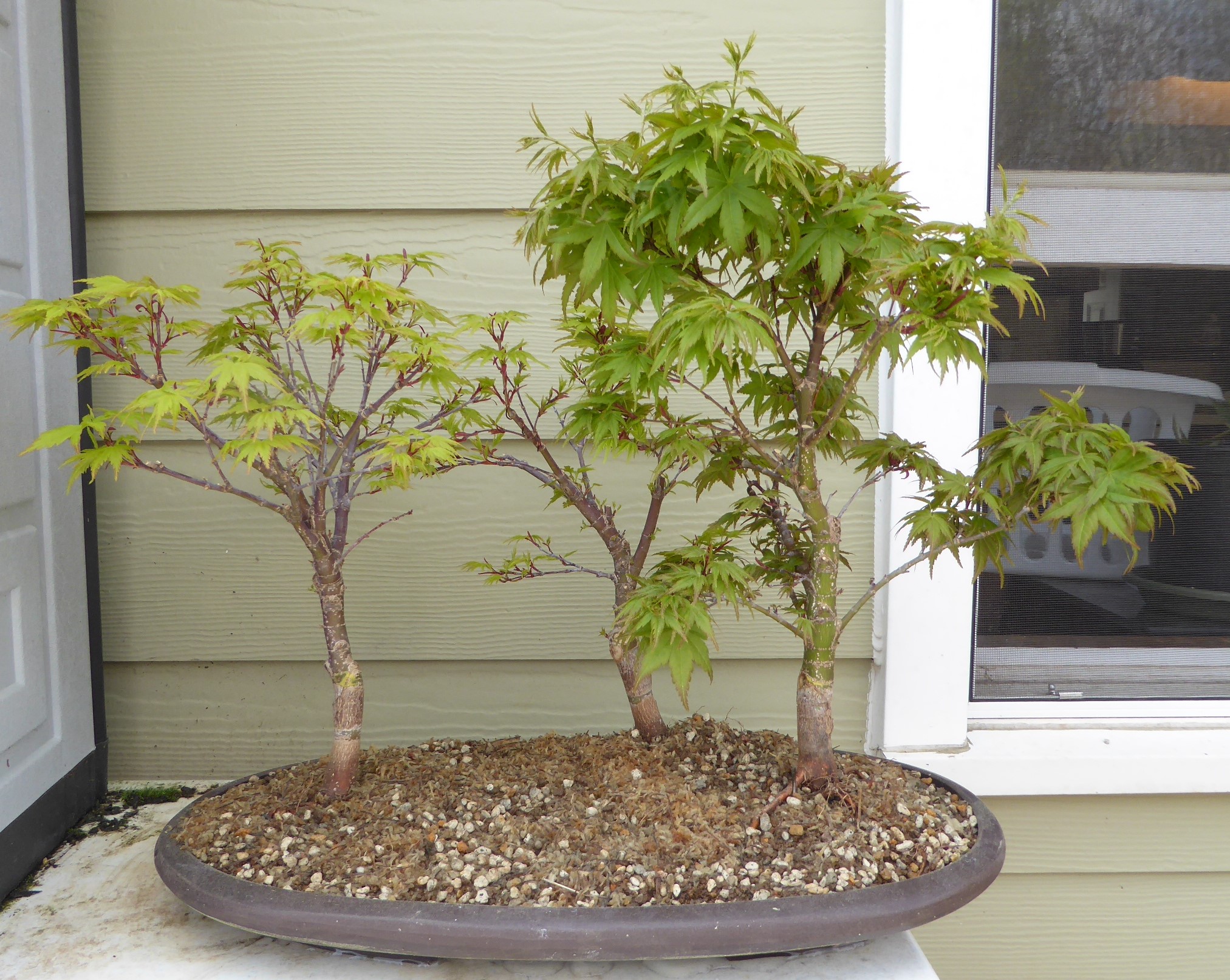
And the juniper is doing beautifully. I’ll give it another month before I look at it for shaping.

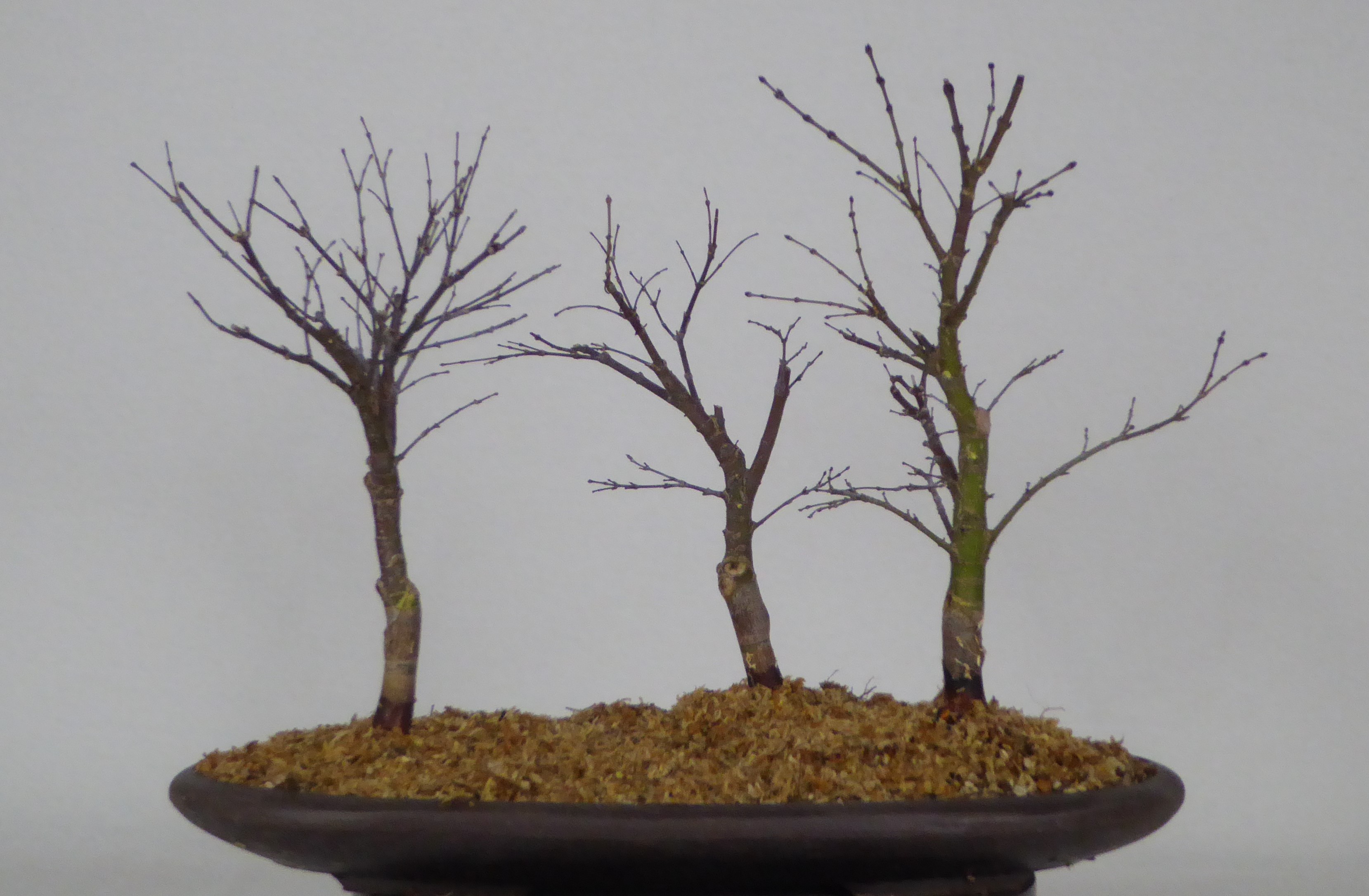
Saturday, I took a day off from work to go the the Bonsai Learning Center in Mooresville, NC to do a workshop that would help me create a Sharp’s Japanese Maple Forest. (The guys doing the workshop prefer the word “forest” to “grove.” I think that when it’s only 3 trees, “grove” is more accurate.


As you do, we denuded the roots and cut them back, using the nob cutter to keep the large outer roots as intact as possible while flattening the bottom. I feels really scary to cut out that much of the big roots. But, they all have good secondary roots and good feeder roots.
I used a plastic pot so we were able to simply drill the necessary holes for my tie downs. A couple of my classmates wanted to start with nicer pots so theirs needed extra work. Brad and Brian used different stuff but, ultimately, had the same idea.


They recommend aluminum wiring for the branches and say to make sure to rewrap gently as they start growing. If the bark grows into the wire, it will cause scars that will never grow over. So, rewiring may need to be done 2 or 3 times in a growing season. I can use copper wire to anchor them without any problem.
There is a layer of grated sphagnum moss on top of the bonsai medium to help keep everything moist.
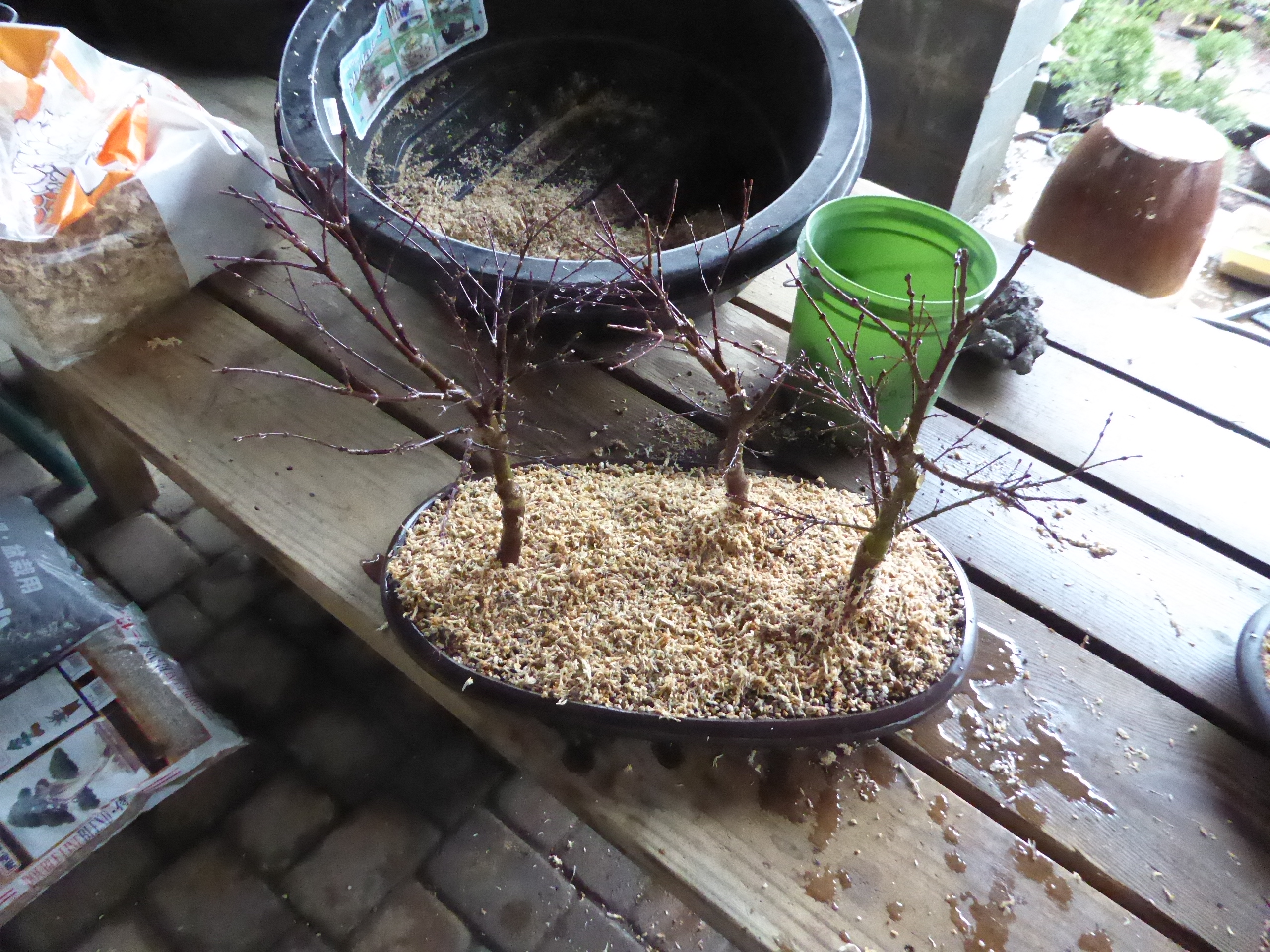
Pinching back the branches will help keep them from getting too long and leggy. I just need to keep an eye on them to remove the growth tips when they start to leaf out.
They need to be maintained for a couple of years as they grow a nice root mat with the roots of all 3 trees intertwined. Then, I can lift them all up in a piece for maintenance. And to move them into a more attractive pot.
Anthony Bourdain wrote:
“Americans love Mexican food. We consume nachos, tacos, burritos, tortas, enchiladas, tamales and anything resembling Mexican in enormous quantities. We love Mexican beverages, happily knocking back huge amounts of tequila, mezcal, and Mexican beer every year. We love Mexican people—we sure employ a lot of them. Despite our ridiculously hypocritical attitudes towards immigration, we demand that Mexicans cook a large percentage of the food we eat, grow the ingredients we need to make that food, clean our houses, mow our lawns, wash our dishes, and look after our children. As any chef will tell you, our entire service economy—the restaurant business as we know it—in most American cities, would collapse overnight without Mexican workers. Some, of course, like to claim that Mexicans are “stealing American jobs.” But in two decades as a chef and employer, I never had ONE American kid walk in my door and apply for a dishwashing job, a porter’s position—or even a job as a prep cook. Mexicans do much of the work in this country that Americans, probably, simply won’t do.
We love Mexican drugs. Maybe not you personally, but “we”, as a nation, certainly consume titanic amounts of them—and go to extraordinary lengths and expense to acquire them. We love Mexican music, Mexican beaches, Mexican architecture, interior design, Mexican films.
So, why don’t we love Mexico?
We throw up our hands and shrug at what happens and what is happening just across the border. Maybe we are embarrassed. Mexico, after all, has always been there for us, to service our darkest needs and desires. Whether it’s dress up like fools and get passed-out drunk and sunburned on spring break in Cancun, throw pesos at strippers in Tijuana, or get toasted on Mexican drugs, we are seldom on our best behavior in Mexico. They have seen many of us at our worst. They know our darkest desires.
In the service of our appetites, we spend billions and billions of dollars each year on Mexican drugs—while at the same time spending billions and billions more trying to prevent those drugs from reaching us. The effect on our society is everywhere to be seen. Whether it’s kids nodding off and overdosing in small town Vermont, gang violence in L.A., burned out neighborhoods in Detroit—it’s there to see. What we don’t see, however, haven’t really noticed, and don’t seem to much care about, is the 80,000 dead in Mexico, just in the past few years—mostly innocent victims. Eighty thousand families who’ve been touched directly by the so-called “War On Drugs”.
Mexico. Our brother from another mother. A country, with whom, like it or not, we are inexorably, deeply involved, in a close but often uncomfortable embrace. Look at it. It’s beautiful. It has some of the most ravishingly beautiful beaches on earth. Mountains, desert, jungle. Beautiful colonial architecture, a tragic, elegant, violent, ludicrous, heroic, lamentable, heartbreaking history. Mexican wine country rivals Tuscany for gorgeousness. Its archeological sites—the remnants of great empires, unrivaled anywhere. And as much as we think we know and love it, we have barely scratched the surface of what Mexican food really is. It is NOT melted cheese over tortilla chips. It is not simple, or easy. It is not simply “bro food” at halftime. It is in fact, old—older even than the great cuisines of Europe, and often deeply complex, refined, subtle, and sophisticated. A true mole sauce, for instance, can take DAYS to make, a balance of freshly (always fresh) ingredients painstakingly prepared by hand. It could be, should be, one of the most exciting cuisines on the planet, if we paid attention. The old school cooks of Oaxaca make some of the more difficult and nuanced sauces in gastronomy. And some of the new generation—many of whom have trained in the kitchens of America and Europe—have returned home to take Mexican food to new and thrilling heights.
It’s a country I feel particularly attached to and grateful for. In nearly 30 years of cooking professionally, just about every time I walked into a new kitchen, it was a Mexican guy who looked after me, had my back, showed me what was what, and was there—and on the case—when the cooks like me, with backgrounds like mine, ran away to go skiing or surfing or simply flaked. I have been fortunate to track where some of those cooks come from, to go back home with them. To small towns populated mostly by women—where in the evening, families gather at the town’s phone kiosk, waiting for calls from their husbands, sons and brothers who have left to work in our kitchens in the cities of the North. I have been fortunate enough to see where that affinity for cooking comes from, to experience moms and grandmothers preparing many delicious things, with pride and real love, passing that food made by hand from their hands to mine.
In years of making television in Mexico, it’s one of the places we, as a crew, are happiest when the day’s work is over. We’ll gather around a street stall and order soft tacos with fresh, bright, delicious salsas, drink cold Mexican beer, sip smoky mezcals, and listen with moist eyes to sentimental songs from street musicians. We will look around and remark, for the hundredth time, what an extraordinary place this is.
The received wisdom is that Mexico will never change. That is hopelessly corrupt, from top to bottom. That it is useless to resist—to care, to hope for a happier future. But there are heroes out there who refuse to go along. On this episode of “Parts Unknown,” we meet a few of them. People who are standing up against overwhelming odds, demanding accountability, demanding change—at great, even horrifying personal cost.”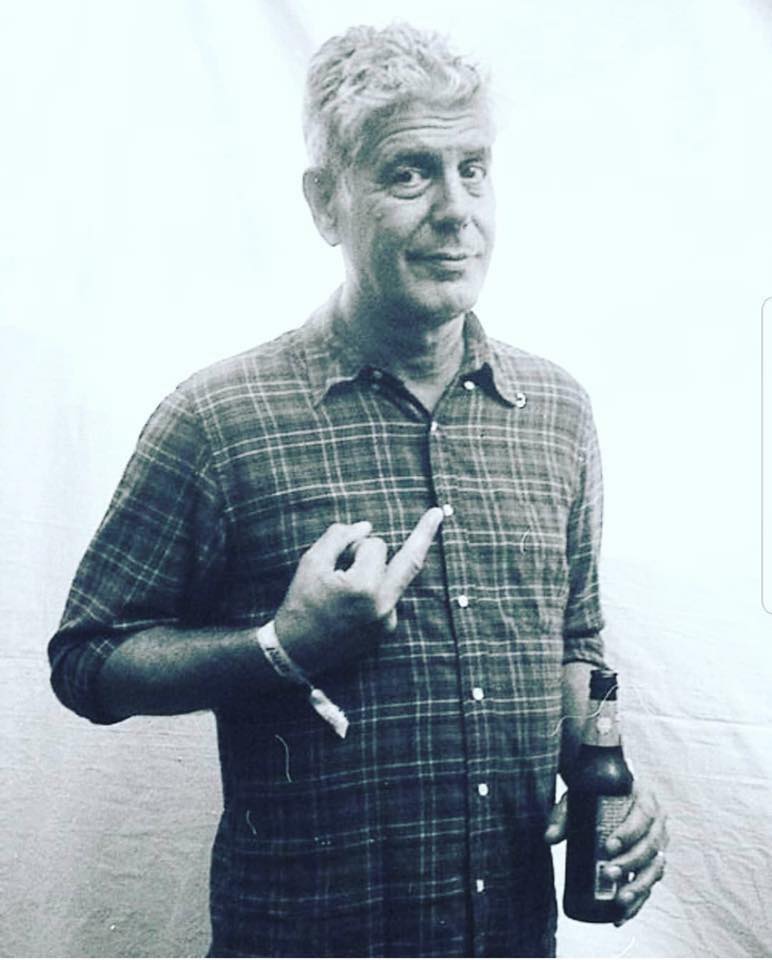
 I am the Audience