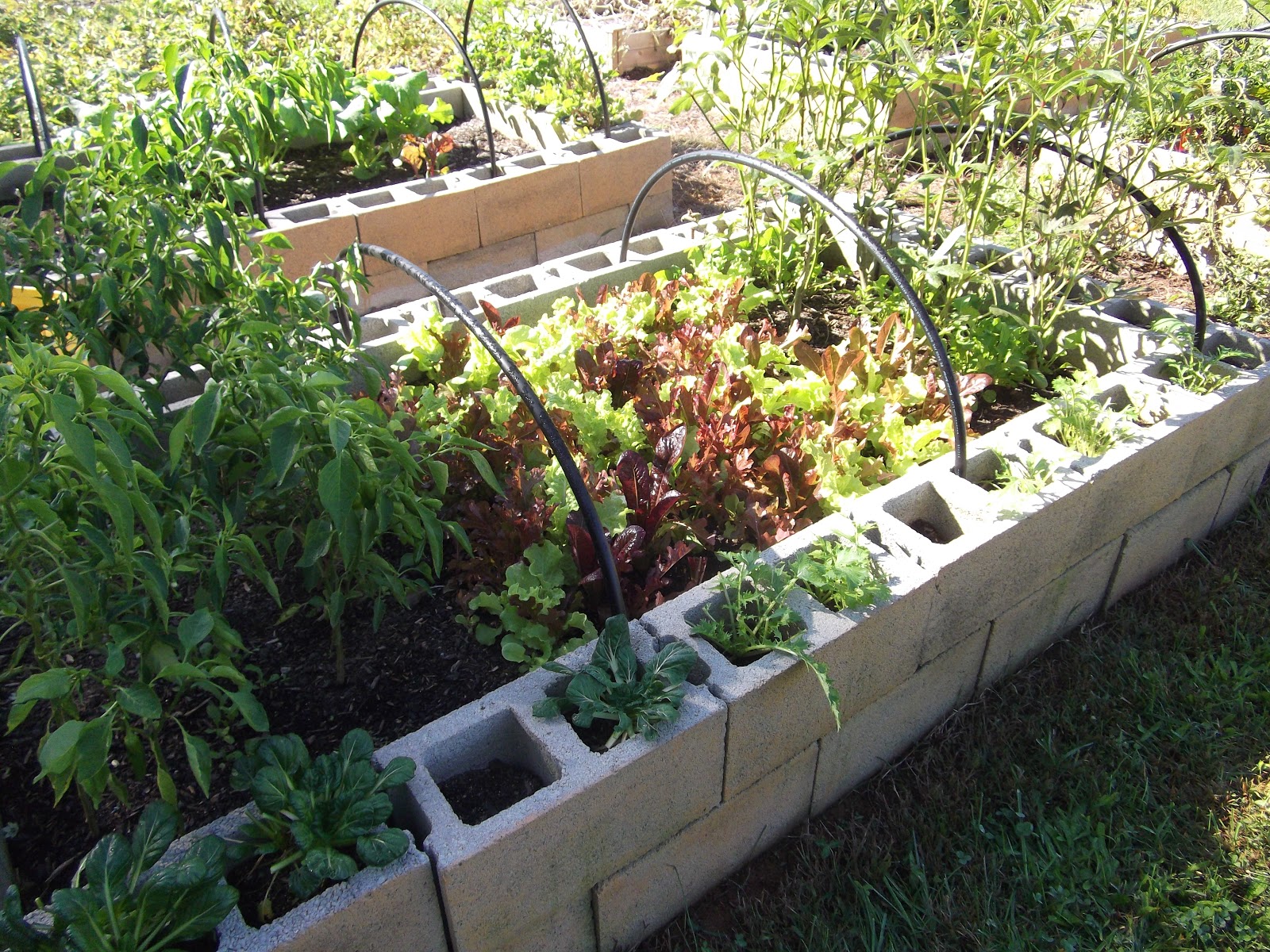
This is where we’ve been shopping for salad, lately.
2 comments on Salad
Looks like it is coming out in November. Was just at the Toronto Film Festival.
More than Honey – Markus Imhoof (Official Trailer) from CIBER Science on Vimeo
Amazing footage! And here is a nice article about it in Outside Magazine.
Been a while since I last posted here. There has been mostly eating, though the summer returns have been a bit sporadic. The early excessive heat and the inconsistent rain has had it’s effect on production. The summer squash finally ran it’s course and I was pretty much ready. I was a bit tired of it. I expect that I will not plant so much of it next spring. We are into Fall and Winter planting right now and I have added two new beds. Lowes had self-contained kits on sale made of cedar, so I thought I would give them a try. I have planted buckwheat in one for the bees to forage during the slow season.

They have been a bit slow in finding it, but have been more interested lately. Kitty pulled the feeders from the hives about a week ago. We are watching to see how they do now that Goldenrod is plentiful and they have Buckwheat just outside their front doors. This morning I planted more Buckwheat in the mulch between five of the Hazelnut bushes just to see if it will sprout there. If so, I will plant more. It grows quickly and lasts until the first frost and is supposed to be a great green compost.

Moving on to the new stuff. Last month I planted Butternut and Spaghetti squash in the other new bed. It is about to take over the yard. There is already fruit and many blossoms. I tend to prefer the winter squash varieties over the summer.


In the bed beside the Buckwheat, I have planted carrots, beets and turnips. In the bed beside the squash, I have planted cabbage, cauliflower and broccoli. In the other upper bed I have planted three varieties of kale. That bed still has thriving chard and a leftover okra plant that is still producing.


Honey is bee food. Beekeepers take honey that bees don’t need in the Springtime when there is a good nectar flow on and the bees have successfully overwintered. Beekeepers who take too much honey at the wrong time can starve their bees. Or find themselves feeding the bees sugar syrup or fondant to make up for the lack of real bee food.
Chuck and I would rather take a little bit of honey, if they have enough to share, and leave the majority to the bees. We are mostly in it for the pollination, but also with the intention of helping to restore honeybee populations
And we hope that our hands-off way of tending the bees will help to restock the feral bee populations that have been hurt by Colony Collapse Disorder. It didn’t just affect commercial beekeepers and honey farmers. It has, also, decimate the wild bees.
Honeybees preceded settlers across the continent as soon as they landed. This was fortunate because so much of the crops that colonists were going to be planting needed those bees. And that hasn’t changed. In order to grown a huge amount of food we eat daily, we need honeybees.
Here are some (but not all) of the things they help pollinate:
Alfalfa, allspice, almonds, apples, apricots, avocados, beans (many varieties), beets, blackberries, blueberries, boysenberries, broccoli, Brussels sprouts, buckwheat, cabbage, cantaloupe, caraway, cardamom, carrots, cashews, cauliflower,celery, cherries (sweet and sour) chestnuts, clover, coconut, coffee, coriander, cotton, cranberries, cucumbers, currants, eggplants, elderberries, fennel, flax, grapes, guava, kiwi, lemon. lime, loquat, macadamias, mangoes, mustard, nectarine, okra, onions, papaya, peas (many, again) peach, pear, persimmon, plum, pomegranate, rapeseed (aka canola), raspberry, safflower, sesame, soybeans, squash (all sorts), strawberries, sunflowers, tangelos, tangerines, turnips, vetch and watermelon.
And notice that some of the crops listed aren’t people food. Alfalfa, clover and vetch are are food for other food.
The other important thing going on with honeybees is that because of how humans have handled them they have been exposed to parasites and diseases that they aren’t ready to deal with. Asian honeybees have developed habits and immunities to varroa mites and the diseases they carry that European honeybees haven’t had time to develop. But because they get moved around the country to pollinate huge monocrops (ie, Florida oranges groves, North Carolina blueberries and California almond orchards that cover an area the size of Rhode Island) they have been exposed to these pathogens fairly regularly.
That has been one of the pieces of the Colony Collapse puzzle.
Now, some beekeepers are raising queens that produce bees that have “hygienic behavior.” And there are treatments for the mites. Unfortunately, the treatments create weak bee colonies with resistant mites.
There is a subculture of beekeepers who are trying to support “survivor bees,” bees that have managed to thrive in spite of varroa without help from humans. These beekeepers let weak colonies die and then restock their hives with swarms caught from healthy hives or feral colonies. And they don’t whine a whole lot if one of their hives swarm away.
So, our hope is to pollinate our garden, get a little honey and to grow healthy bees that will help the Colony Collapse Disorder recovery.
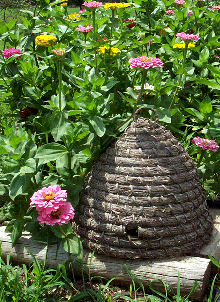
The old fashioned kind of straw hives seen in childrens’ books are called skeps and they are simply empty cavities for the bees to do with as they will. They give bees a place to live, but the whole hive has to be destroyed in order to remove any honey or to check for diseases so they really aren’t a good choice if you want to keep that colony.
There are, generally, 3 types of beehives used by modern beekeepers. They all have movable parts that allow beekeeper access to the comb so that they can to check on brood and to harvest honey.
The Langstroth hive was patented in 1852 by an American clergyman named Lorenzo Langstroth and is used by commercial beekeepers because they are easy for humans to manage. They have frames that guide how the bees make their comb and they frequently have wax foundation to give the bees a start. This helps beekeepers have more standardized comb that makes honey harvesting easier. The frames also allow the use of centrifuges (called extractors) to remove the honey from comb that has had the caps sliced off. After honey extraction, the frames are put back in the hives where the bees get to work cleaning the cells up and refilling them, using less resources to get back up to speed than when other types of hives are used. The frames are also sturdier than free hanging comb and, therefore, are easier to transport to crops that need pollination or to get a particular type of desirable honey flavor like tupelo, orange blossom or sourwood.
Langs generally have a brood box on the bottom and honey boxes “super”-ed above the brood. Supers may be deep, medium or small. Some commercial beekeepers use a queen excluder to keep her from climbing up into the supers and laying brood where the beekeeper is trying to acquire harvestable honey. If there is brood, the honey can’t be used. But if the nectar flow is good and they have enough space, this isn’t a problem.

The “nationals” of the UK are a variation on this theme.
Top Bar and Warré hives are often preferred by “natural” beekeepers. (There was some argument on the email list of our local beekeepers association, with some holding that any bee tending is unnatural and that the term is an oxymoron. Whatever.) Natural beekeepers’ purpose is to support the health and well-being of honeybees with as little intervention as the humans can bear to let happen. Some people have an easier time keeping out of it than others. Chuck occasionally has to talk me down. We have determined how we intend to look after the bees and when I get to frettin’, he reminds me of what we know and what we have decided is our way of bee support.
Anyway, the point of these other varieties of hive is to try to provide a space that is more similar to the kind of place bees use when they are completely wild. There are no frames, after all in hollow trees.
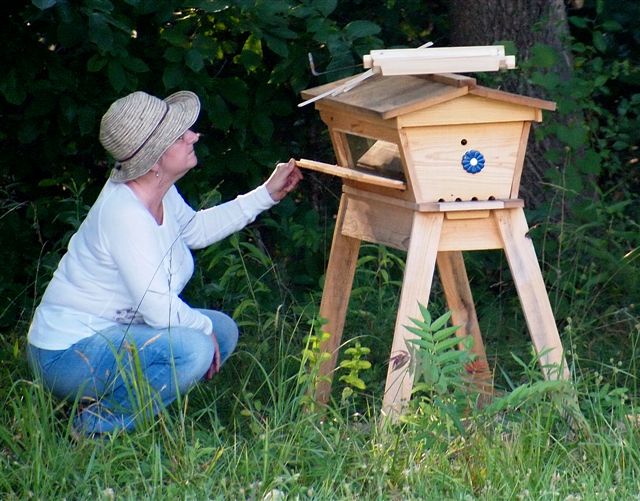
Top Bar Hives were developed to be easy to build with simple tools and use without a great deal of fuss. Kenyans have angled sides and Tanzanians have straight sides. (Ours are Kenyan.) They provide a long, hollow space with bars that are spaced to be convenient for bees to build comb down from and also convenient for beekeepers to lift out for honey harvesting. The only lifting you do with TBHs is lifting the top up to get to the bars.
The angled sides is because bees don’t like to attach to angled sides as much as they do to straight sides. They attach support wax, but don’t build all the way out as they do in straight sided frames or hive boxes. Tanzanian TBHs sound like a pain in the ass to me but it does have a little more space.

TBHs provide honey for the bees and the beekeeper. But, because there is no foundation, the bees have to replace to comb from scratch that has been lost when honey was harvested . So, a lot more bee effort goes into comb building than in frames with foundation.. And they have less time to store honey when they have to spend time building comb first. And in order to leave them enough to get through dearths (winter or summer dry periods when nothing is blooming), humans need to take less.
This isn’t a good way for commercial honey producers to house their staff. It is fine if you just want to pollinate your garden and have a little treat for yourself on occasion.
TBHs frequently have windows in the side so beekeepers can look in to see how things are going with out actually removing the bars and disturbing the bees.
Warré, also called a Vertical Top Bar, was developed by Abbé Émile Warré in the middle of the 20th century. The Abbé’s book on beekeeping, translated by Patricia and David Heaf, can be found HERE.

Warré hives work on the principal that bees draw comb down. So, the main colony is in the top and the lower space is where honey storage happens. They use bars rather than frames and have a quilt in the top to absorb moisture and to help insulate against extreme heat and cold.
Abbé Warré believed that bees don’t need human help and users of Warrés mess with the bees the least, generally opening the hives only twice a year for a checkup and a honey harvest.
There are variations on these, long hives, which are sort of beehive duplexes, Perones, which take Warrés a step further and some others. There are also beekeepers who are using other shapes like hexagons and dodecahedrons to see how those alterations work. But, as far as I can see, these three are the basic starting place for new beekeepers to decide what hive style best suits their way of tending bees.
 I am the Audience